A Tailors Guide: How Bustles Transform Your Wedding Gown.
A Tailor’s Guide: How Bustles Transform Your Wedding Gown:
What Is a Bustle?
The Why and How
A bustle is more than a practical solution; it is a moment of transformation.
Picture this: you glide down the aisle, your train trailing behind you in breathtaking elegance.
But after the ceremony?
That same train could become a tangled inconvenience.
Enter the bustle.
A bustle is a clever technique used by tailors to lift and secure a gown’s train so you can move freely during the reception.
It lets you preserve the look of your gown while protecting the fabric from dirt and damage.
Tailors use discreet hooks, buttons, loops, or ribbons to gather the train and fasten it in a way that complements the dress’s original silhouette.
There is no one-size-fits-all solution here.
The bustle is a fully custom detail designed to suit the specific gown, the fabric, the bride’s movement, and even the venue.
The artistry lies in making it blend so seamlessly that no one notices it is there, even while your dress is completely transformed.
The Different Bustle Types – A Tailor’s Perspective
Each bustle type offers its own blend of style, support, and personality.
Knowing which works for your gown helps create a clean, comfortable, and confident fit.
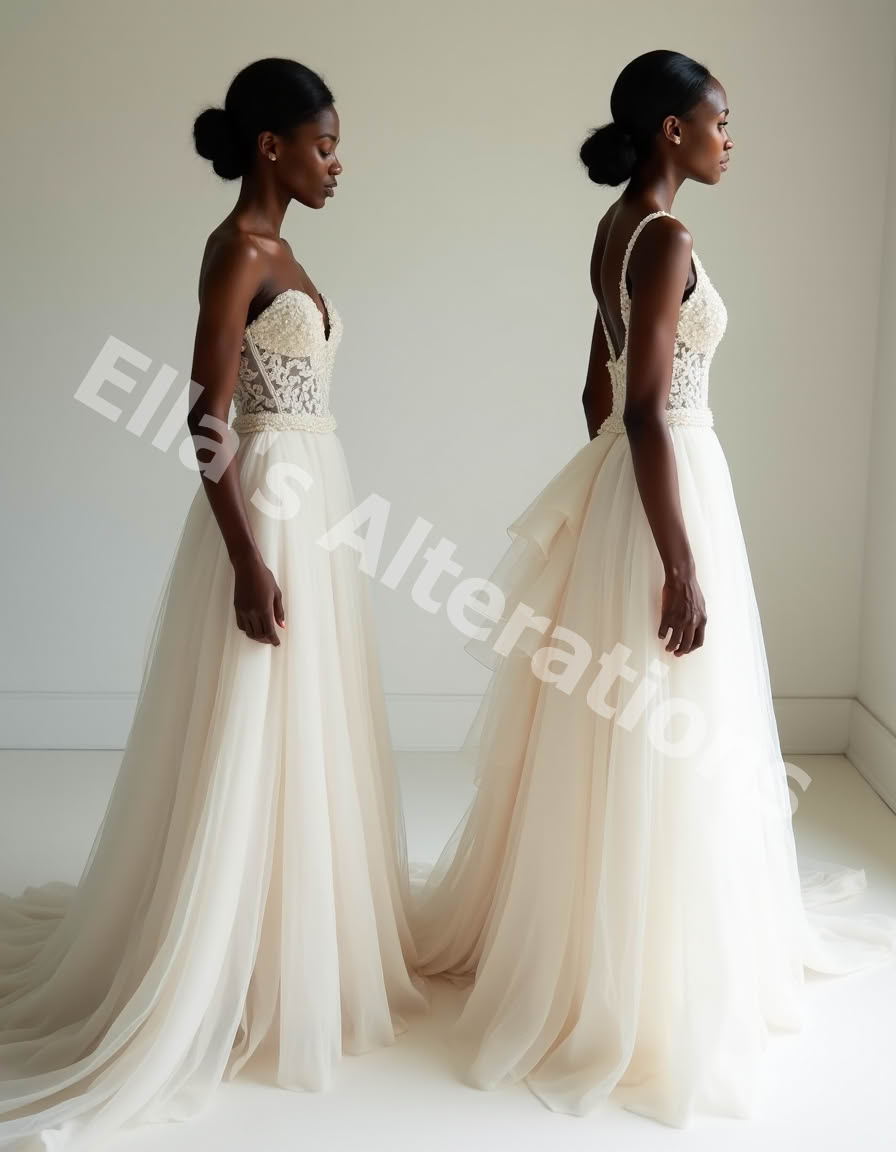
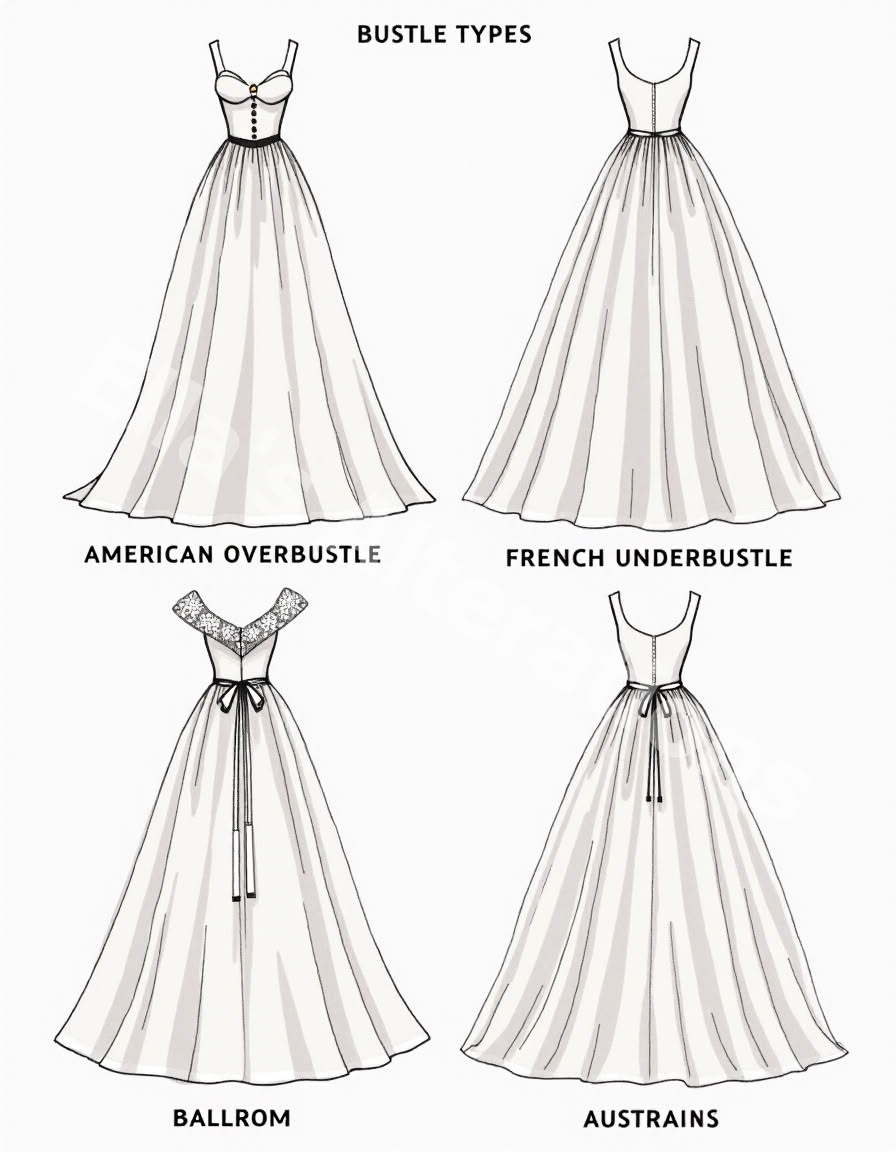
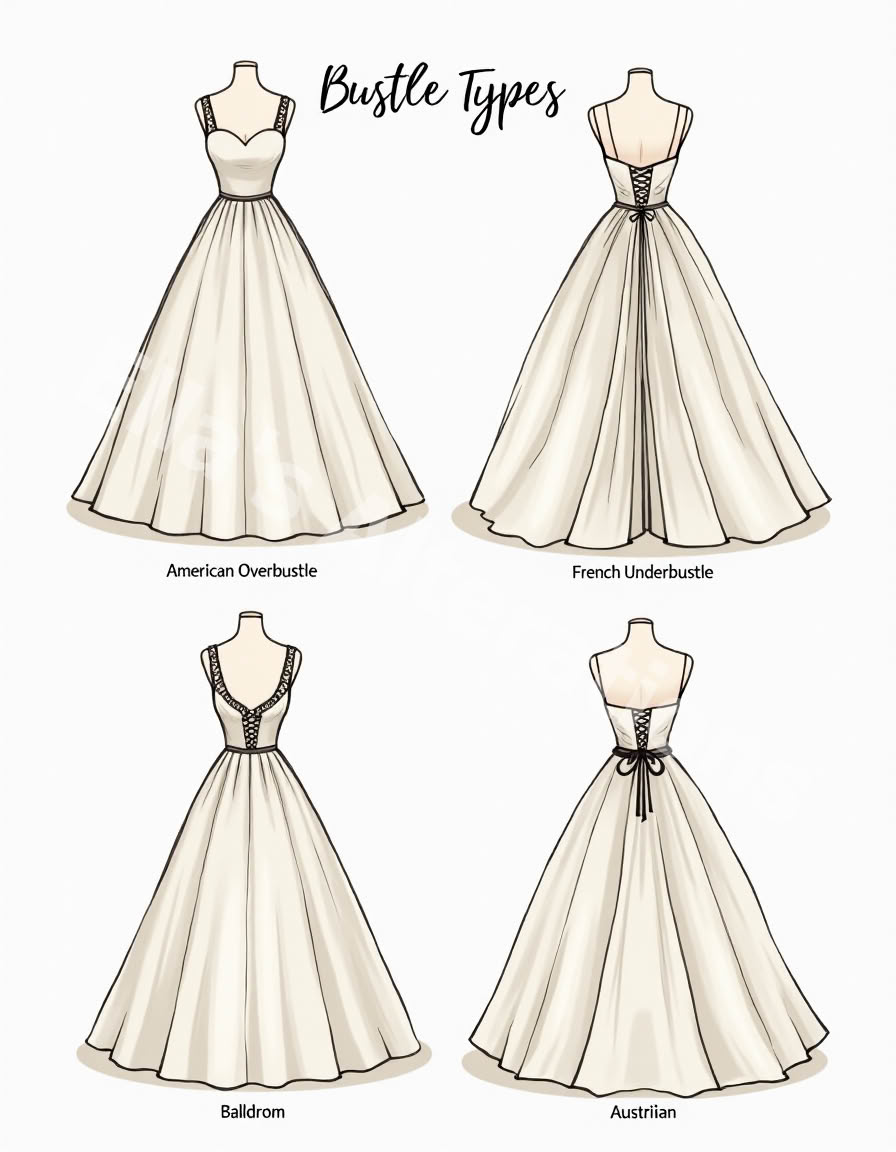
The American Bustle (Overbustle) is one of the most common types.
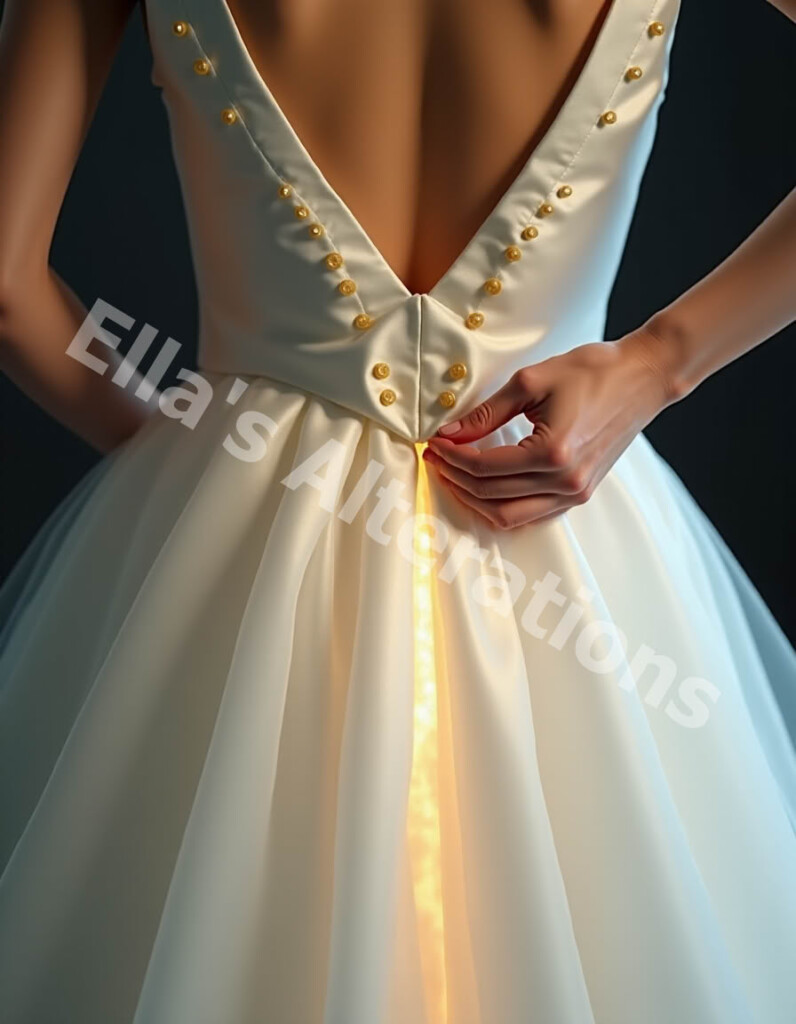
The train is lifted and fastened over the top of the skirt using buttons or loops placed along the gown’s back.
This works beautifully with heavier fabrics like satin or brocade and fuller silhouettes such as ballgowns and A-lines.
It creates visible folds and a dramatic, structured look that’s especially appealing for traditional brides.
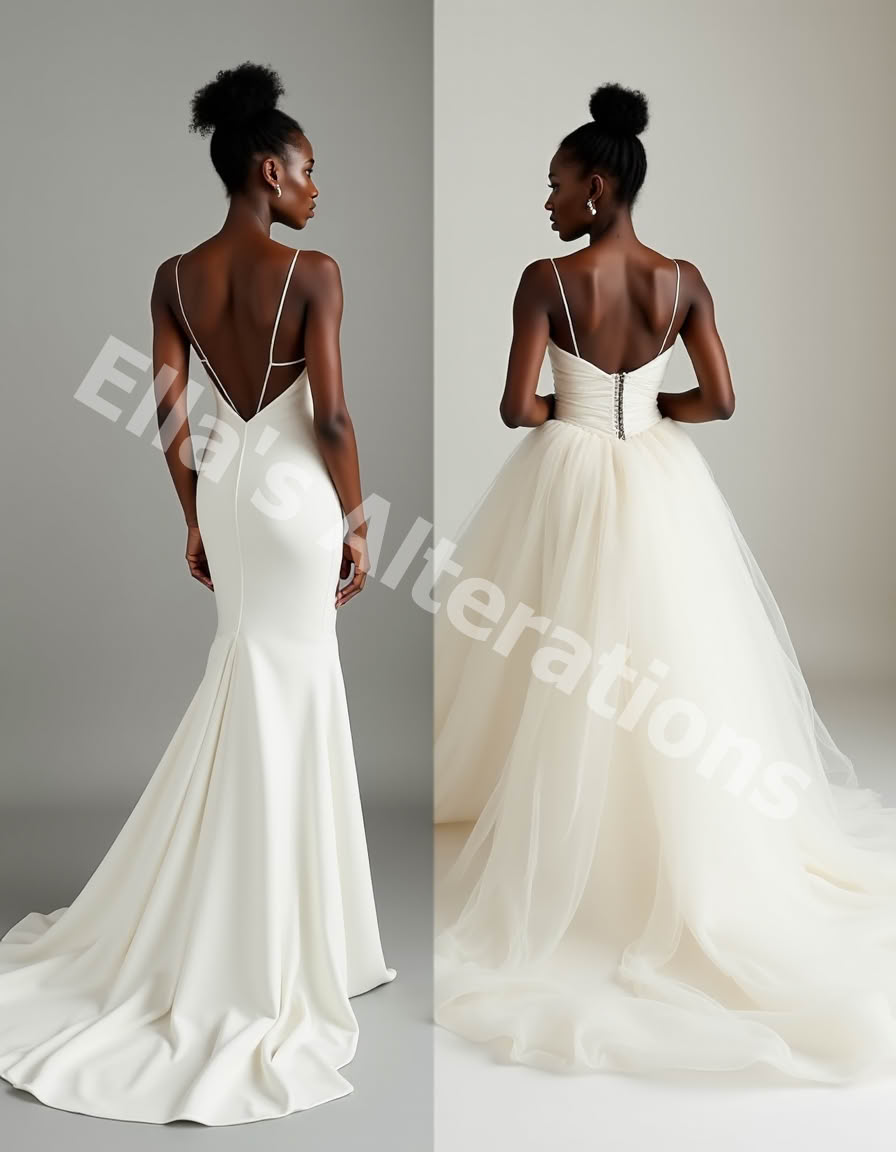
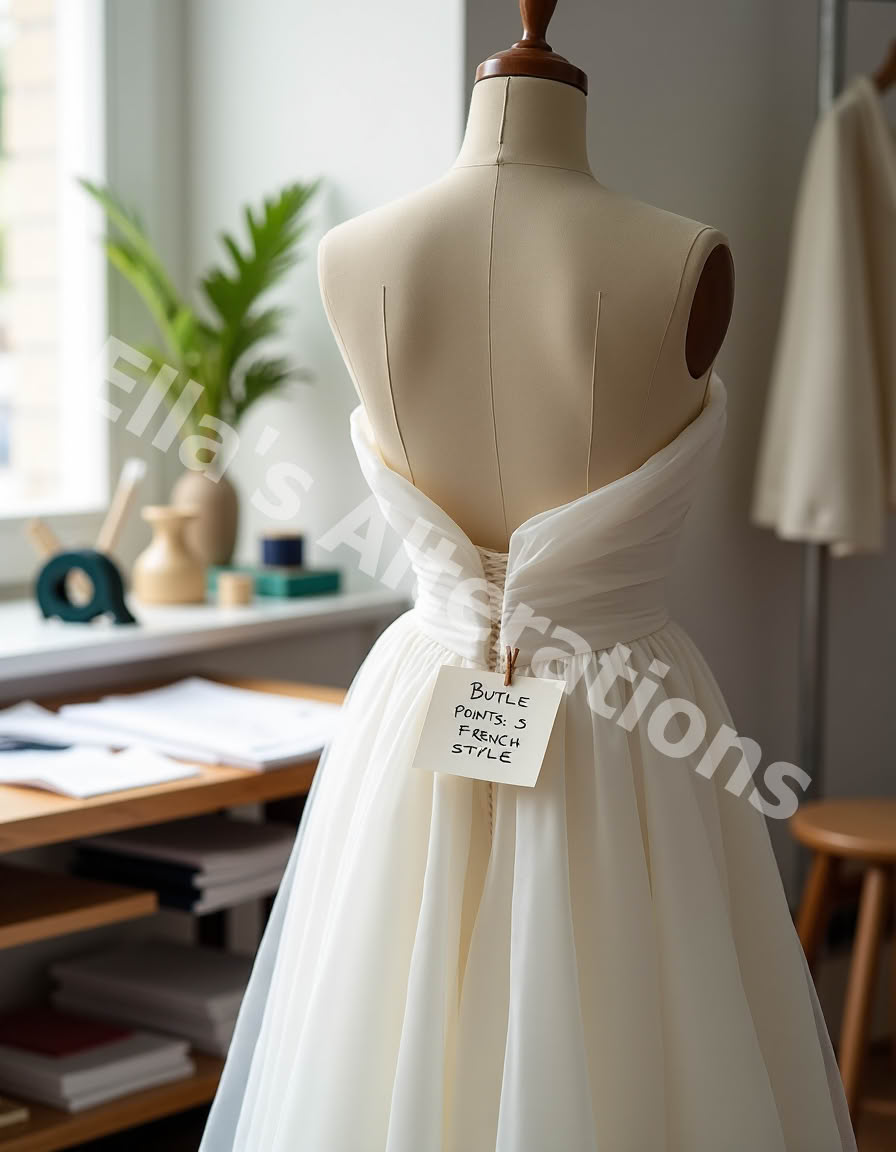
The French Bustle (Underbustle) is more hidden and subtle.
Here, the train is folded and tucked underneath the gown, secured with ribbons sewn into the gown’s lining.
This creates soft draping and layers without interrupting the external fabric.
French bustles are perfect for form-fitting gowns like mermaid or trumpet styles, especially those made with lace or intricate beading.
They preserve the silhouette while allowing graceful movement.
The Ballroom Bustle goes even further, lifting the entire train under the dress to match the front hem length.
When done right, it looks like the dress never had a train at all.
This is the best choice for brides who want maximum freedom to dance and move without worrying about stepping on their gown.
It is especially ideal for heavy, dramatic trains that need full support and total transformation for the reception.
The Austrian Bustle is less common but incredibly striking.
This style uses vertical ruching—gathering the fabric up the center back like a drawstring curtain.
It works best on lightweight, unembellished dresses where the fabric texture becomes the focus.
Brides looking for a modern or couture-inspired look often choose this for its fashion-forward flair.
Matching the Bustle to the Gown’s Silhouette
Matching your bustle to your gown’s shape is key to preserving your overall look.
A mismatch can cause puckering, pulling, or awkward volume.
- A-line and Ballgowns do well with American or ballroom bustles, as these can manage volume while keeping a balanced shape.
- Mermaid and Trumpet silhouettes need French or underbustles to maintain their figure-hugging fit.
- Sheath and Column dresses pair best with minimal bustle points or styles like the Austrian bustle that preserve a clean vertical line.
- Gowns with Intricate Details such as lace, embroidery, or appliqué benefit from bustles that lift fabric gently and avoid disrupting embellishments—usually French or custom ribbon bustles.
Best For… At-a-Glance Guide
- American Bustle: For classic, structured dresses with full skirts and formal vibes.
- French Bustle: For romantic, curve-hugging gowns with delicate detailing.
- Ballroom Bustle: For brides who want freedom to dance and complete transformation.
- Austrian Bustle: For sleek, simple gowns that shine with creative texture.
Choosing the right bustle blends form and function, ensuring your dress works with you throughout the entire celebration.
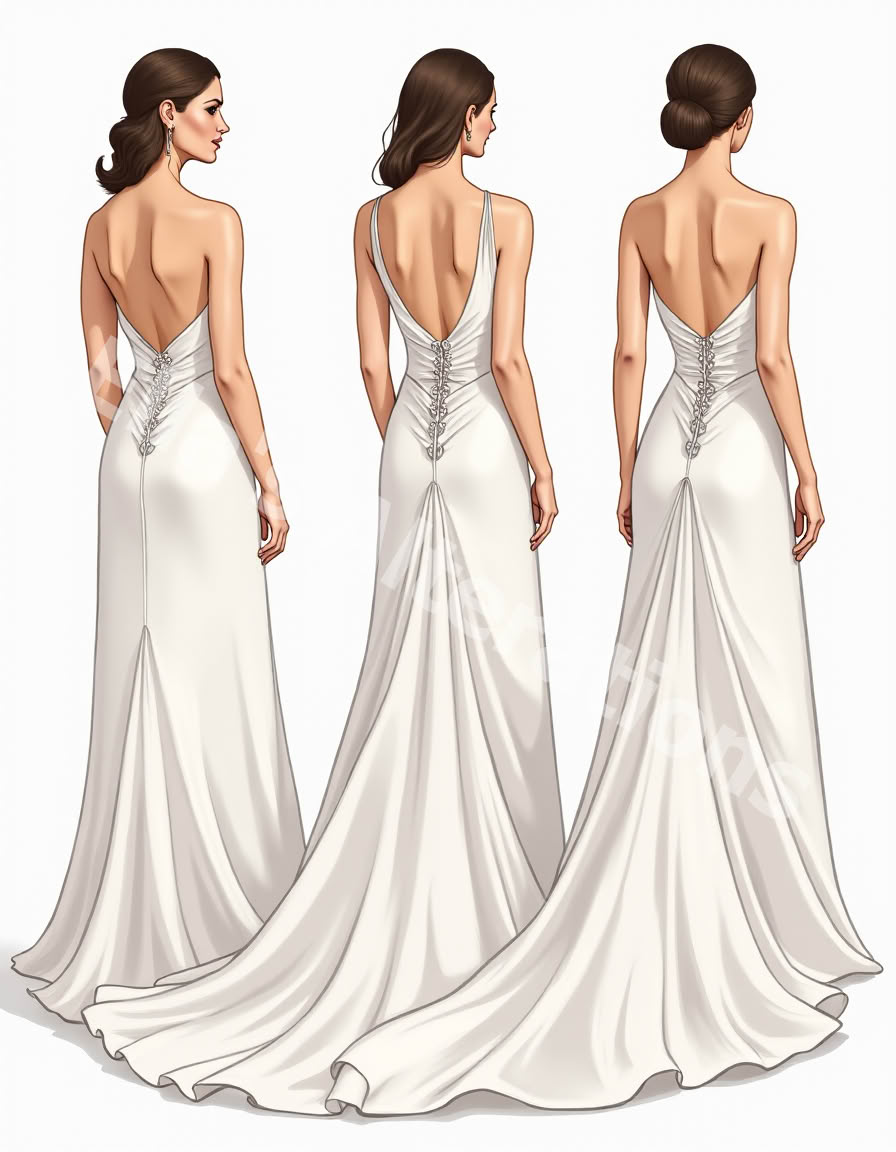
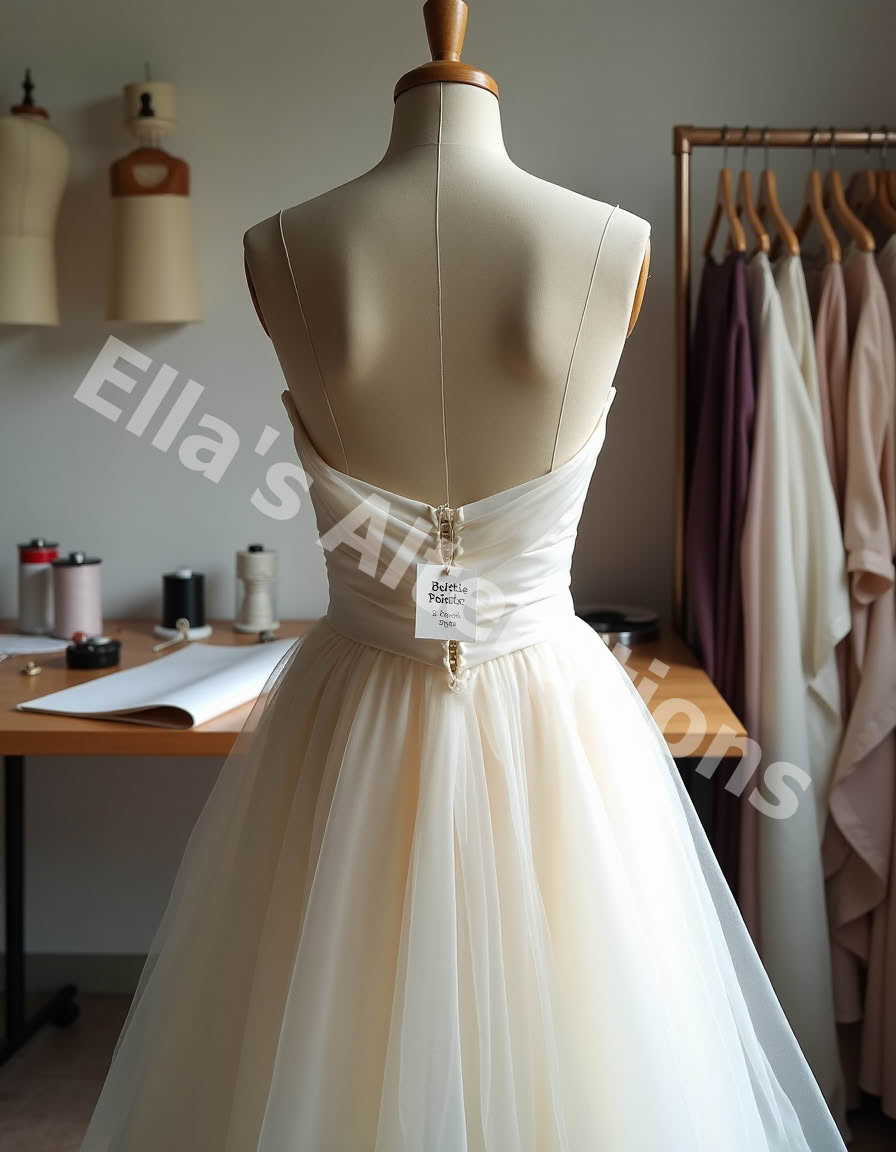
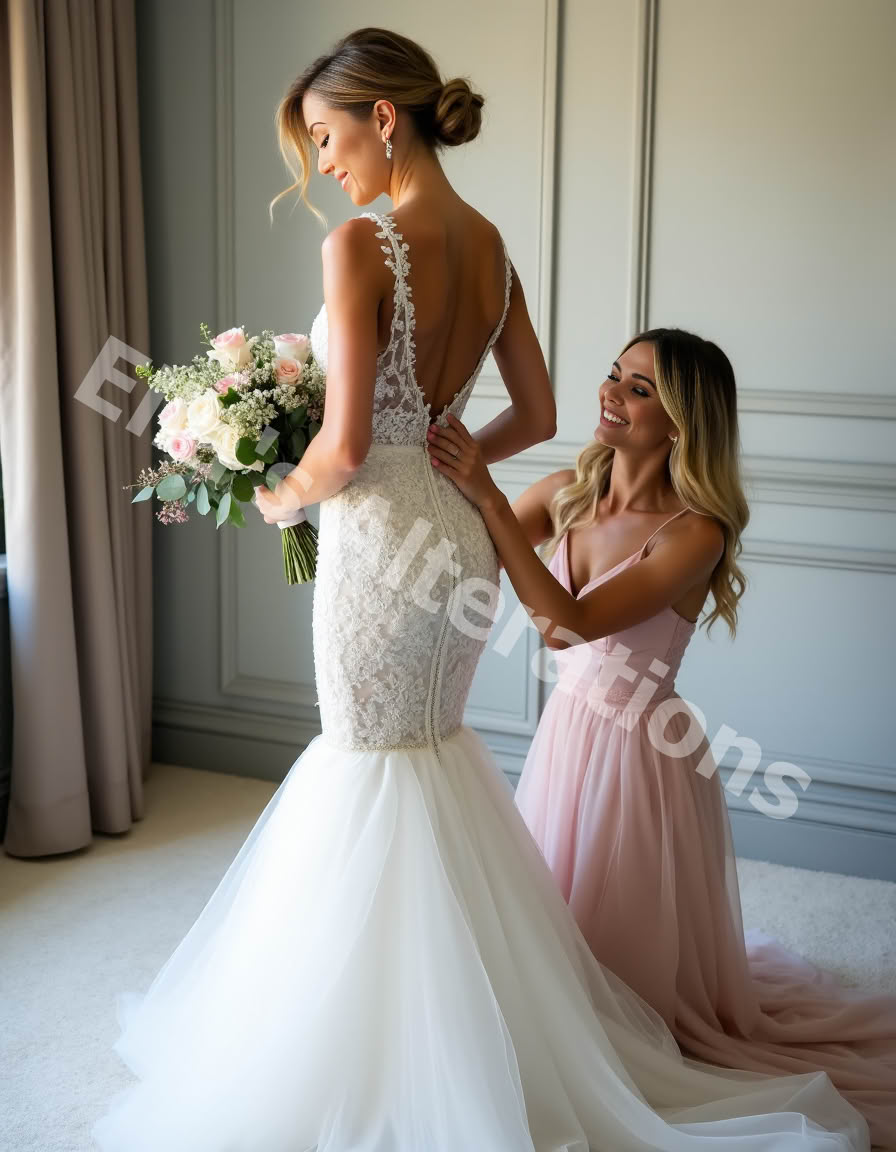
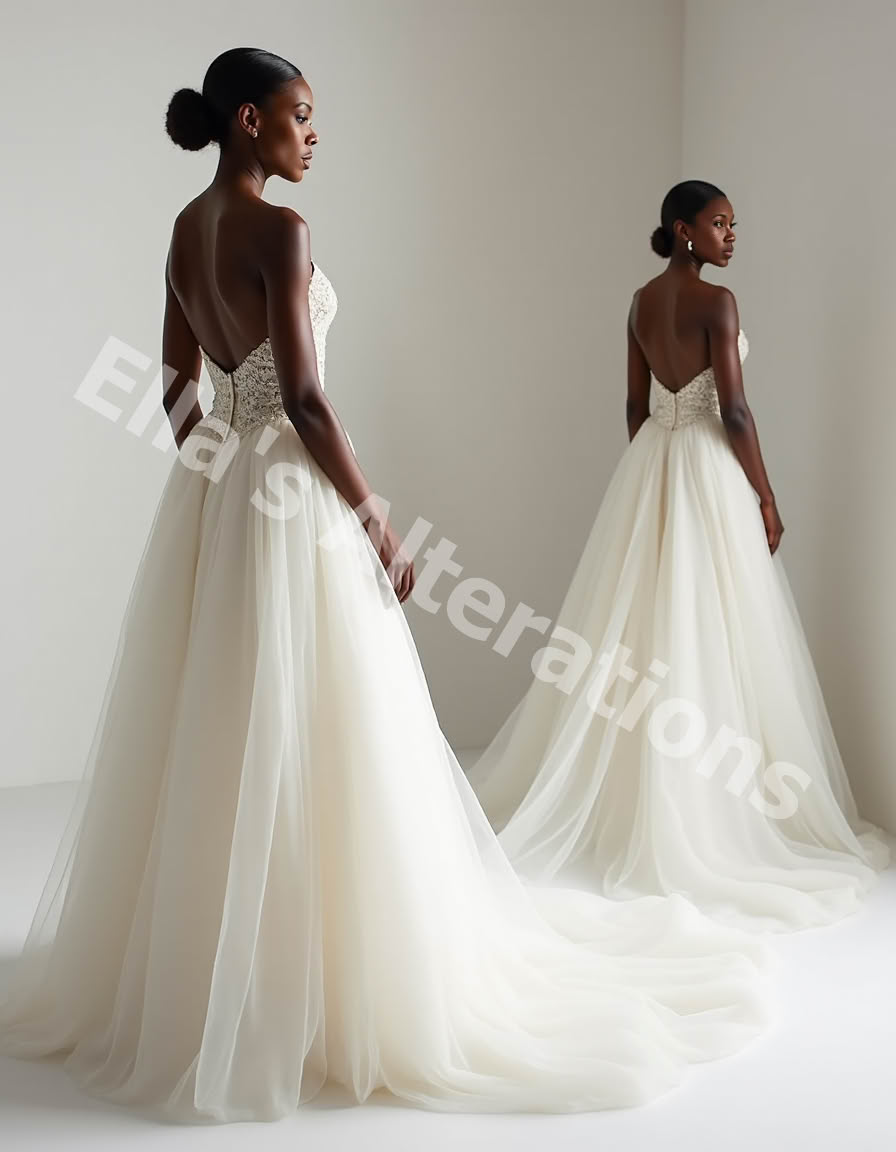
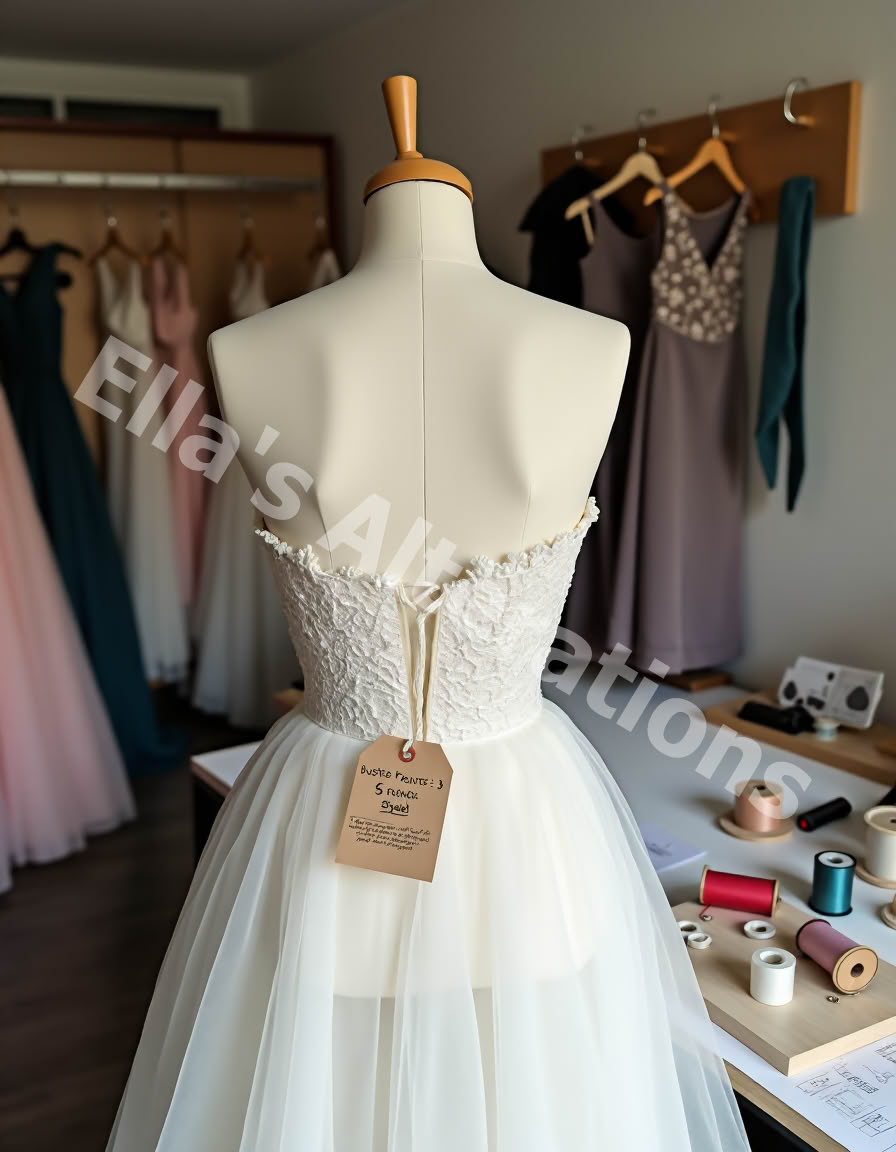
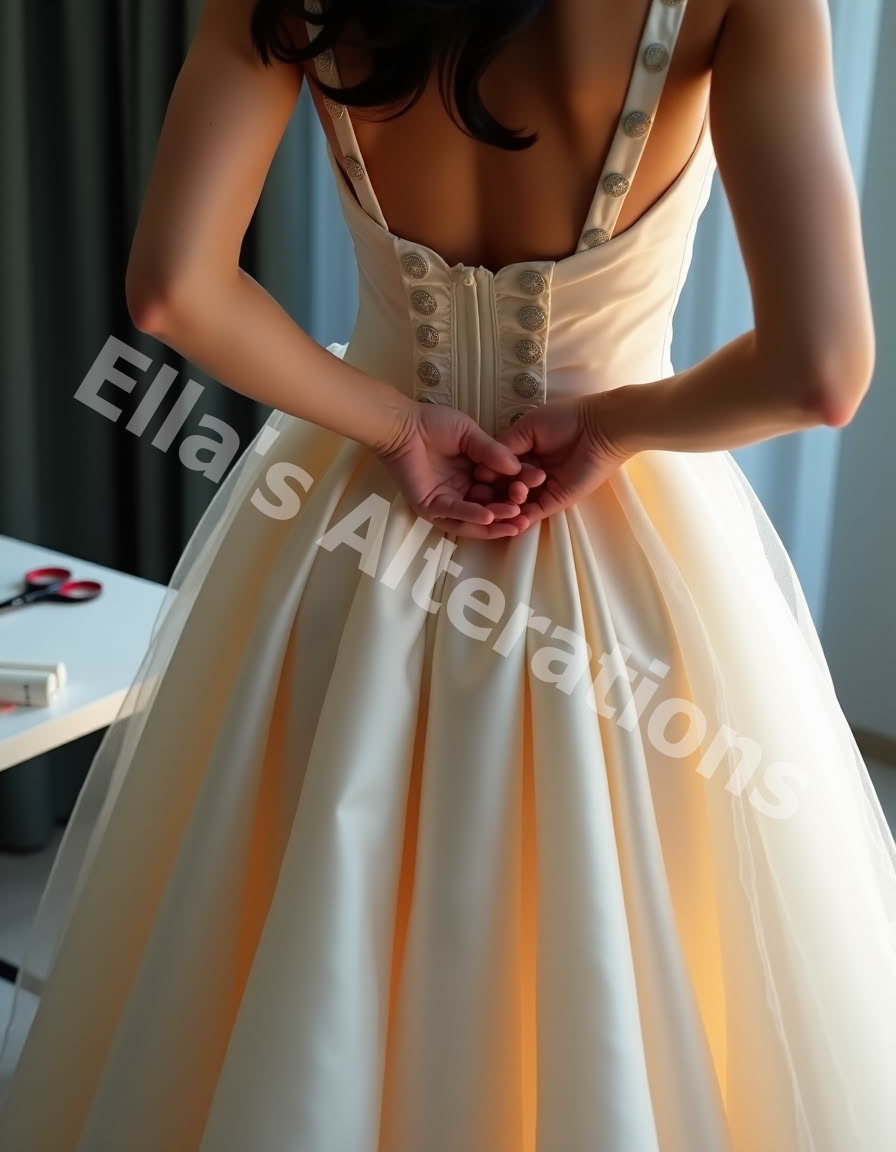
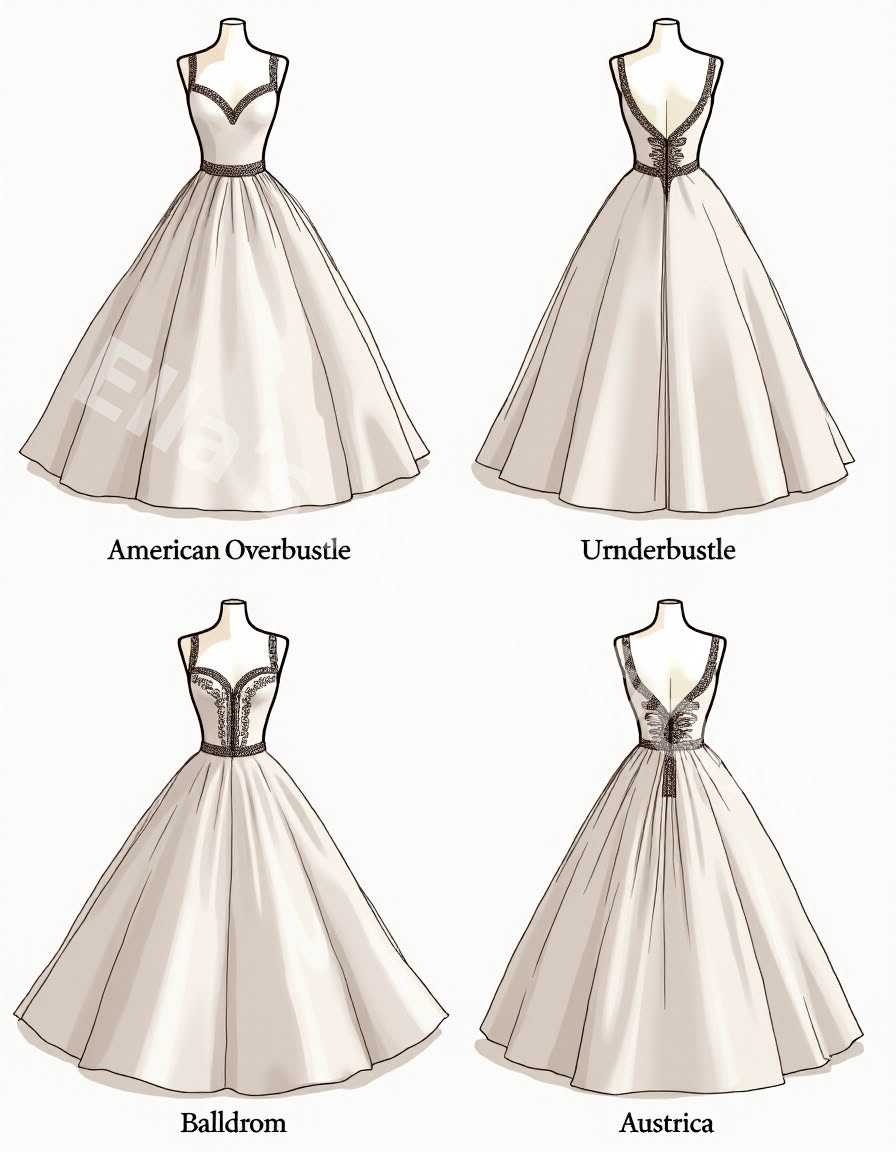
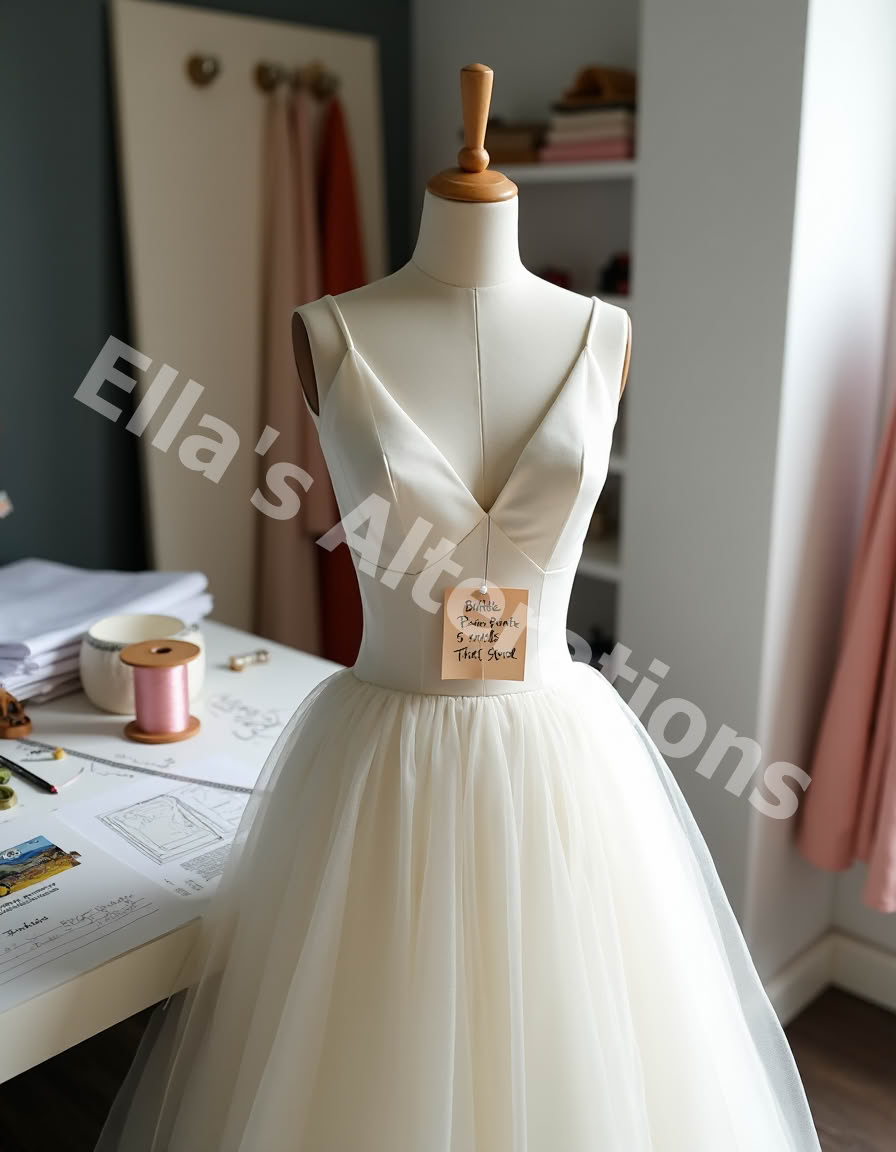
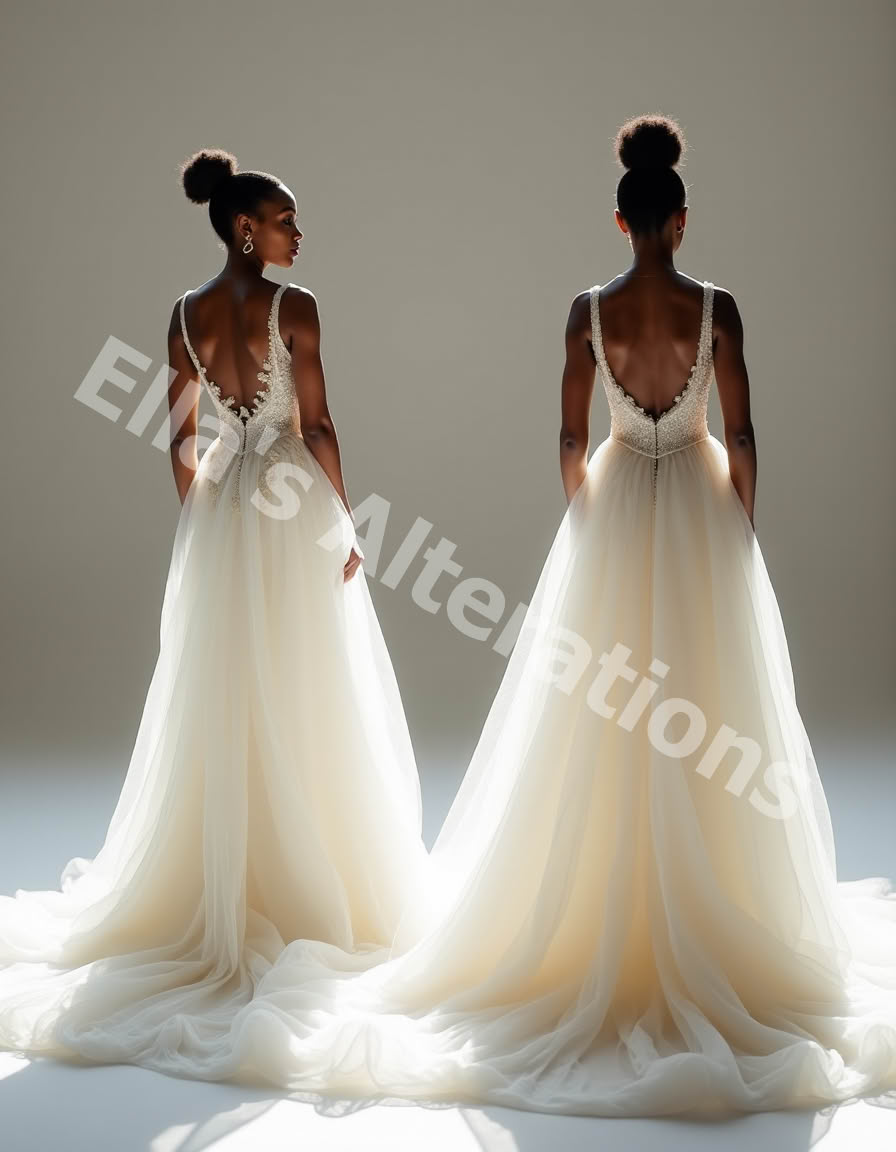
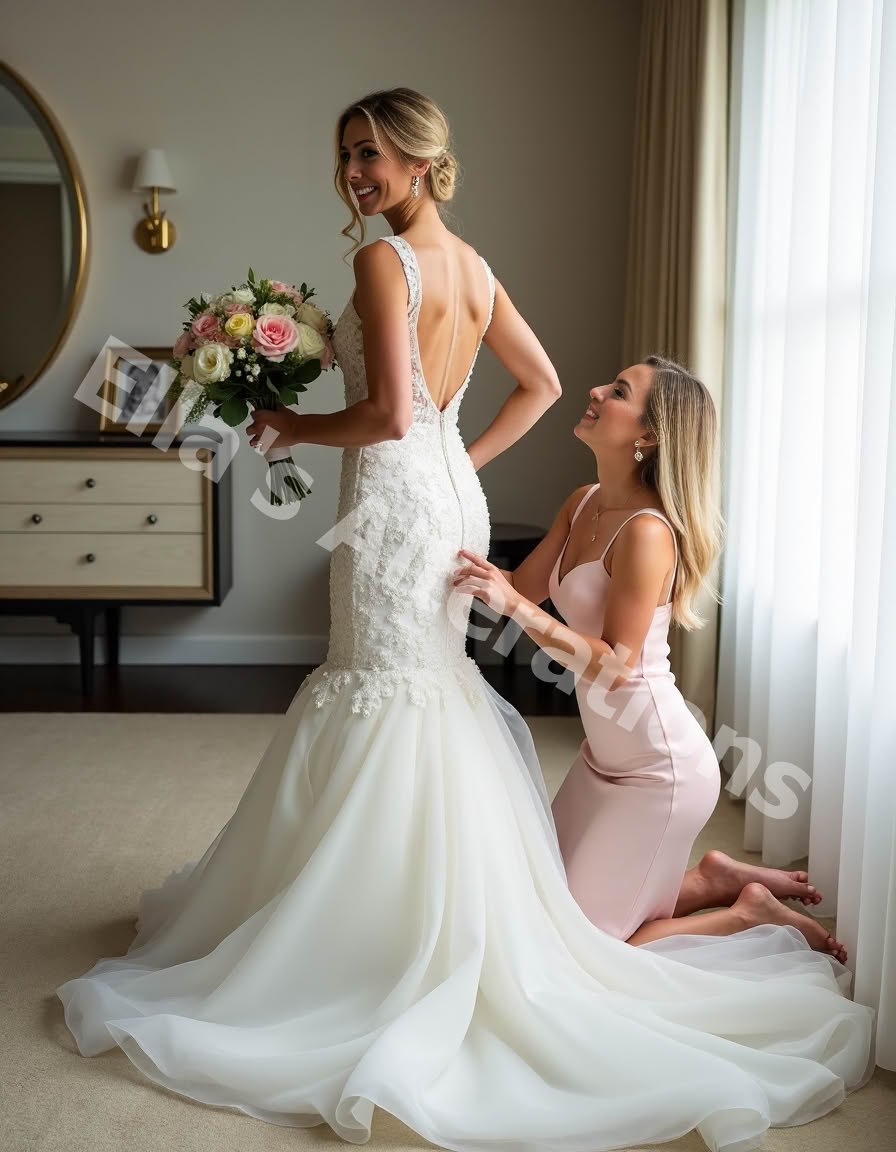
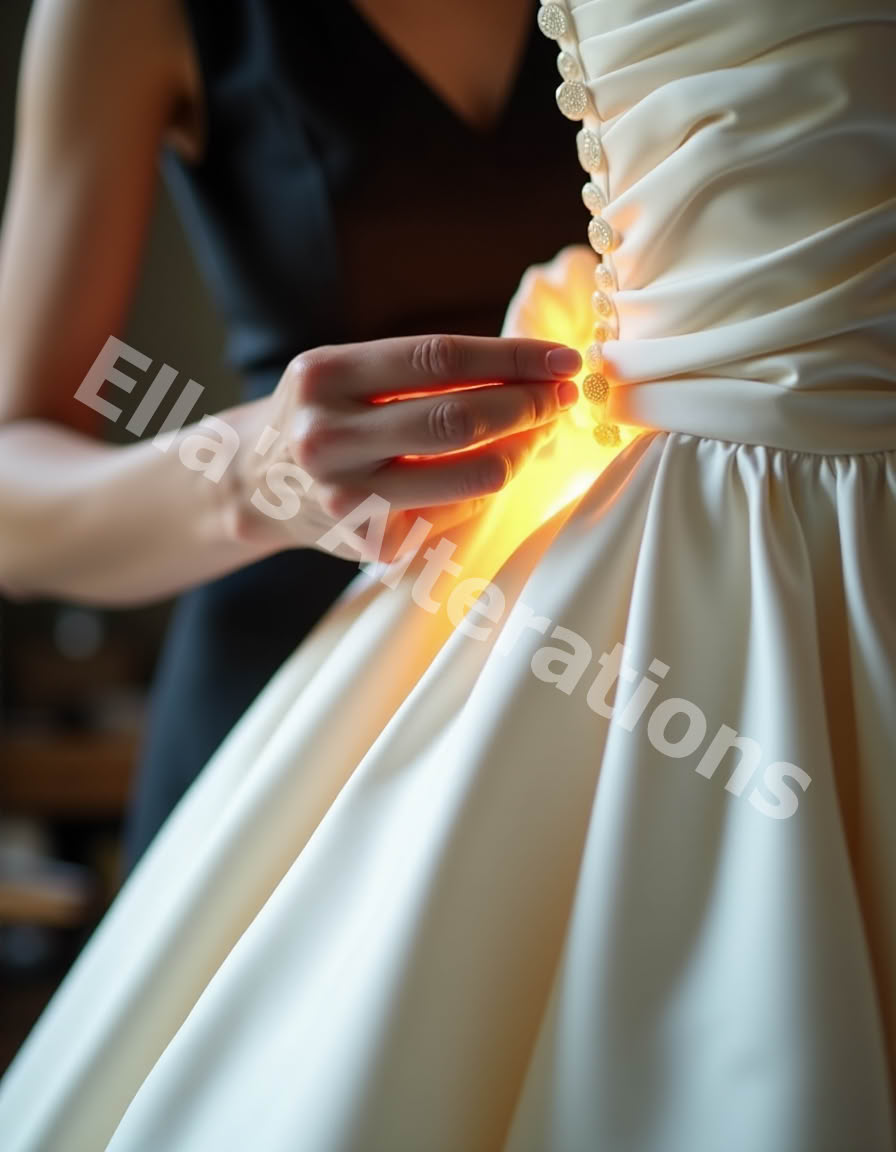
A Little Lift, a Lot of Magic:
When you first try on your dream wedding gown, there’s an undeniable magic in how it flows behind you.
The train trails with romance, every step echoing your bridal vision.
But fast forward to the reception, where you’ll be greeting guests, dancing with your partner, and maybe even hitting the buffet—suddenly, that beautiful train becomes something to manage.
That’s where a little-known tailoring miracle steps in: the bustle.
A bustle may not be the most glamorous detail, but it is one of the most transformative.
In fact, it can be the single alteration that takes your gown from “walking down the aisle” to “dancing the night away” without missing a beat.
And here’s the secret—when done right, a bustle doesn’t change your dress.
It enhances it.
Bustles are practical and stylish tailoring elements that lift and secure the train of your wedding gown.
They give your dress versatility and functionality while maintaining its beauty.
Think of it like having two looks in one.
During the ceremony, your train brings all the drama.
At the reception, your bustle lets you move, dance, and celebrate freely—no dragging, no tripping, no stress.
Still, choosing a bustle isn’t just about lifting fabric.
It’s about preserving the integrity of your silhouette and the vision you’ve had for your gown since the first fitting.
The right bustle supports the structure of your dress, complements the fabric’s natural drape, and keeps your look cohesive from start to finish.
Whether you’re wearing a voluminous ballgown or a sleek satin sheath, there’s a bustle that will match it perfectly.
Of course, this isn’t a one-size-fits-all kind of thing.
That’s where your tailor or seamstress becomes your style partner.
They’ll study how your gown moves, where the weight falls, how the fabric flows, and how the hemline behaves.
Then, they’ll strategically place invisible buttons, loops, ribbons, or hooks to shape your bustle in a way that flatters both you and your dress.
Think of your bustle like the dress’s secret tool kit.
It’s there to serve your movement, protect your train, and make sure nothing distracts from your wedding day glow.
The best part?
When expertly done, your guests won’t even notice it.
All they’ll see is a gown that seems to adjust with you as the day unfolds.
But here’s the thing most brides don’t realize until it’s almost too late: bustles need to be planned ahead.
During your alterations, you’ll try out different bustle types, see how they feel, and choose the one that gives you both beauty and balance.
There’s a bit of trial and error, a few pins here and there, and maybe a few laughs as your stylist practices bustling it with you.
And let’s be honest—your bustle isn’t just about logistics.
It’s part of the whole vibe.
Maybe you want a soft, vintage feel.
Or a clean, tailored finish.
Maybe you’re all about surprise elements, and you want your reception entrance to feel like a gown reveal.
No matter your style, a bustle helps complete your bridal transformation.
From ceremony grace to reception ease, the bustle is your gown’s hidden hero.
It’s the little lift that lets your love story shine without interruption.
Elegant, functional, and completely tailored to you—it’s not just an alteration.
It’s an elevation.
Wedding Dresses, What To Expect and How To Alter
What Is a Bustle? The Why and How:
For the skilled tailor, a bustle is more than a wedding gown detail—it’s a structural modification that blends form, function, and finesse.
It’s the finishing touch that ensures a gown maintains its shape, silhouette, and elegance long after the ceremony ends.
And unlike hemming or taking in seams, bustling a wedding dress requires foresight, creativity, and a deep understanding of movement and drape.
So what exactly is a bustle?
In tailoring terms, it’s a system designed to lift, gather, and secure the train of a gown without altering the original hemline.
It allows the bride to move with ease and confidence during the reception, all while maintaining a seamless look.
The bustle transitions the gown from ceremonial grandeur to functional elegance—without the need for a second dress.
The bustle must be custom-built, never assumed.
As tailors, we analyze the construction of the gown—where the seams fall, how the fabric reacts under tension, the gown’s weight, and the shape it was designed to hold.
This isn't just about attaching ribbons and calling it a day.
It’s about reading the gown like a blueprint and building a bustle that disappears into the design, yet performs like a mechanical support system.
Every fabric speaks differently.
- Taffeta holds a sharp fold, while chiffon needs a softer, less invasive lift.
- Satin reflects light—meaning every button and loop must be placed with extra care to avoid unwanted shadows or puckering.
- Lace, especially hand-appliquéd, demands hidden attachment points that won’t disturb its intricate detailing.
As tailors, we aren’t just supporting fabric.
We’re protecting the garment’s integrity while improving its performance.
A well-constructed bustle is invisible until it’s needed.
That’s where our eye for line and balance comes in.
Every lift point affects how the hemline reads and how the silhouette reacts.
Too much tension, and the shape warps.
Too little support, and the train drags or shifts.
A single misjudged placement can throw off the symmetry or pull the gown off-center, especially in figure-hugging silhouettes.
We also consider movement.
- Can the bride walk, turn, and sit without pulling at the structure?
- Will the bustle hold during dancing, or will she need reinforcements mid-reception?
These are practical questions, but they inform everything from the type of fastening we use (hook-and-eye, button loop, ribbon tie) to the number of points we install.
Some gowns need just one discreet lift.
Others demand five or more.
Timing is also part of our process.
Bustling is typically the last step in alterations, once the hem is finalized and the dress has had a full fitting.
But it must be tested before delivery.
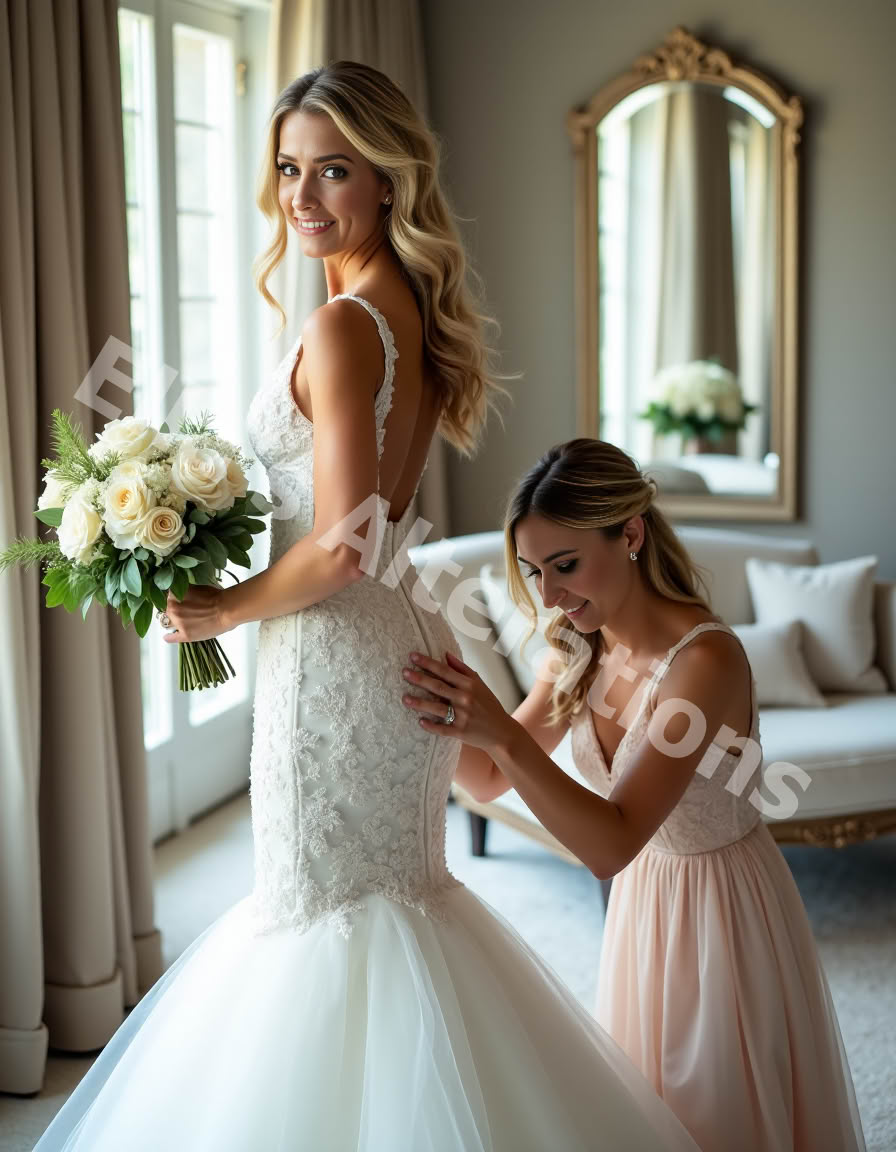
We walk the client through bustling and unbustling the gown, often training a bridal party member to assist on the day of the event.
Our goal is to make sure the bustle enhances—not hinders—the bride’s experience.
Ultimately, a bustle is a tailor’s signature—subtle, essential, and built for movement.
It’s proof that behind every picture-perfect twirl and sweeping reception entrance, there’s a craftsman who designed that dress to do more than look stunning.
It was tailored to move with grace and ease, just like the bride wearing it.
In our hands, a bustle is not just a lift.
It’s a transformation, engineered with intention and finished with polish.
The Different Bustle Types – A Tailor’s Perspective:
When it comes to bustle work, not all designs are created equal—and as tailors, we know this isn’t just about preference.
It’s about structural alignment, weight distribution, and preserving the integrity of the silhouette.
Each bustle type requires different techniques, materials, and placement strategies.
The right choice depends on the gown’s fabric, style, and how the bride plans to move through her day.
Below are the most commonly requested bustle types and how we, as tailors, approach them with precision.
The American Bustle (Overbustle)
This is the most traditional and widely recognized bustle style.
The train is lifted and secured on the outside of the gown, usually with buttons or loops sewn along the back seam or between the waist and mid-hip level.
As tailors, we favor this approach for A-line and ballgown silhouettes, especially those made with heavier, structured fabrics like satin, taffeta, or brocade.
The challenge lies in controlling volume.
If not evenly distributed, the bustle can distort the balance of the skirt or create bunching that competes with the gown’s shape.
We place anchor points symmetrically and often reinforce them with internal stitching to handle the weight.
The folds should be crisp and deliberate, not chaotic.
The French Bustle (Underbustle)
The French bustle offers a hidden solution.
The train is folded underneath the gown and attached with ribbons or buttons sewn into the lining.
This technique is ideal for brides who want to keep a clean exterior line, especially those wearing mermaid or trumpet gowns where silhouette is everything.
From a tailoring standpoint, the underbustle demands planning.
It’s essential that the anchor points are completely invisible yet still accessible enough for quick fastening.
You must also anticipate fabric tension when the dress is in motion.
Lighter laces and chiffons work beautifully here, but heavier materials require stronger internal construction.
We often double-line the contact area to protect against wear.
The Ballroom Bustle
For gowns with long, dramatic trains—especially full ballgowns—the ballroom bustle offers full-floor symmetry.
The entire train is lifted and tucked under the dress, aligning the hem all the way around.
The result is a 360-degree transformation that gives the illusion that the gown never had a train.
This style requires more bustle points than most.
As tailors, we typically map out five to seven points minimum, ensuring weight is evenly distributed to avoid sagging.
We use strong, flexible fastenings and often reinforce seams to support the gown’s full weight.
Accuracy is critical here.
Misplaced points will create a warped hemline or throw off the gown’s symmetry.
The Austrian Bustle
Less conventional but increasingly in demand, the Austrian bustle uses a vertical drawstring effect up the back of the dress.
The fabric is ruched from the hemline toward the mid-back, creating a gathered drape that almost mimics pleated curtains.
This style works best with lightweight, pliable fabrics like chiffon, organza, or crepe.
From a tailor’s perspective, the Austrian bustle requires strategic channeling.
We often build a hidden casing inside the gown and run a ribbon or cord through it, allowing the bride to adjust the gather manually.
It’s a sophisticated touch that reads modern and high-fashion, perfect for minimalist gowns where the texture becomes the focus.
Choosing with Intention
Each of these bustle styles can be elevated with clean craftsmanship, thoughtful construction, and knowledge of fabric behavior.
As tailors, our responsibility is not only to support the gown but also to respect its design.
A bustle should never interrupt the flow—it should integrate so naturally that it becomes an invisible asset to the overall look.
More than a simple add-on, a bustle is a test of tailoring mastery.
Done right, it redefines the gown’s versatility without compromising its artistry.
Matching the Bustle to the Gown’s Silhouette:
Creating a well-executed bustle is not just about lifting fabric.
It’s about preserving the silhouette that the designer—and ultimately the bride—fell in love with.
As tailors, we understand that each wedding gown is engineered with specific lines, proportions, and movement in mind.
The bustle must enhance those characteristics, not interrupt them.
To do this, we start by identifying the gown’s silhouette and determining how the train behaves when lifted.
A-line and Ballgowns
These silhouettes carry more volume through the skirt and often feature substantial trains made from structured fabrics.
The goal when bustling these gowns is to maintain the balance of fullness while lifting the train cleanly off the floor.
The American overbustle or the ballroom bustle works especially well here.
The American bustle creates an elegant, tiered effect that blends beautifully with the natural shape of the skirt.
It lifts the train onto the outer layer, allowing the fullness to remain intact while keeping it under control.
If the train is long or heavy, a ballroom bustle may be more appropriate.
This design pulls the entire train underneath the dress, making it look like the gown had no train to begin with.
It’s the most functional option for movement while still keeping the dress looking voluminous and regal.
Mermaid and Trumpet
These gowns are built to hug the body and flare out at or below the knee, which means the silhouette is easily distorted by improper bustling.
For these shapes, less is more.
The French bustle is often the best solution.
It lifts the train underneath the skirt, allowing the exterior to remain smooth and uninterrupted.
The underbustle also supports the flare in the skirt by tucking fabric upward without creating unsightly bulges or pulling at the seams.
Precision matters here.
Bustle points must be perfectly aligned with the skirt’s natural drape and weight to maintain that signature hourglass look.
We often use multiple internal ribbons or snaps, reinforced with careful hand stitching, to ensure nothing slips or shifts during wear.
Sheath and Column
These gowns are narrow and sleek, often made with lightweight fabrics like crepe, chiffon, or satin.
Because there is minimal structure and almost no volume to hide bustle points, we tailor our approach with subtlety in mind.
A single-point overbustle or a modified Austrian bustle works best here.
Austrian bustles add texture without overwhelming the gown.
When placed correctly, the vertical ruching adds a soft focal point that still feels cohesive with a minimal silhouette.
On simpler dresses, a tailored single-point bustle may be all that is needed to lift the train just enough for movement while keeping the hemline clean and modern.
Gowns with Intricate Details
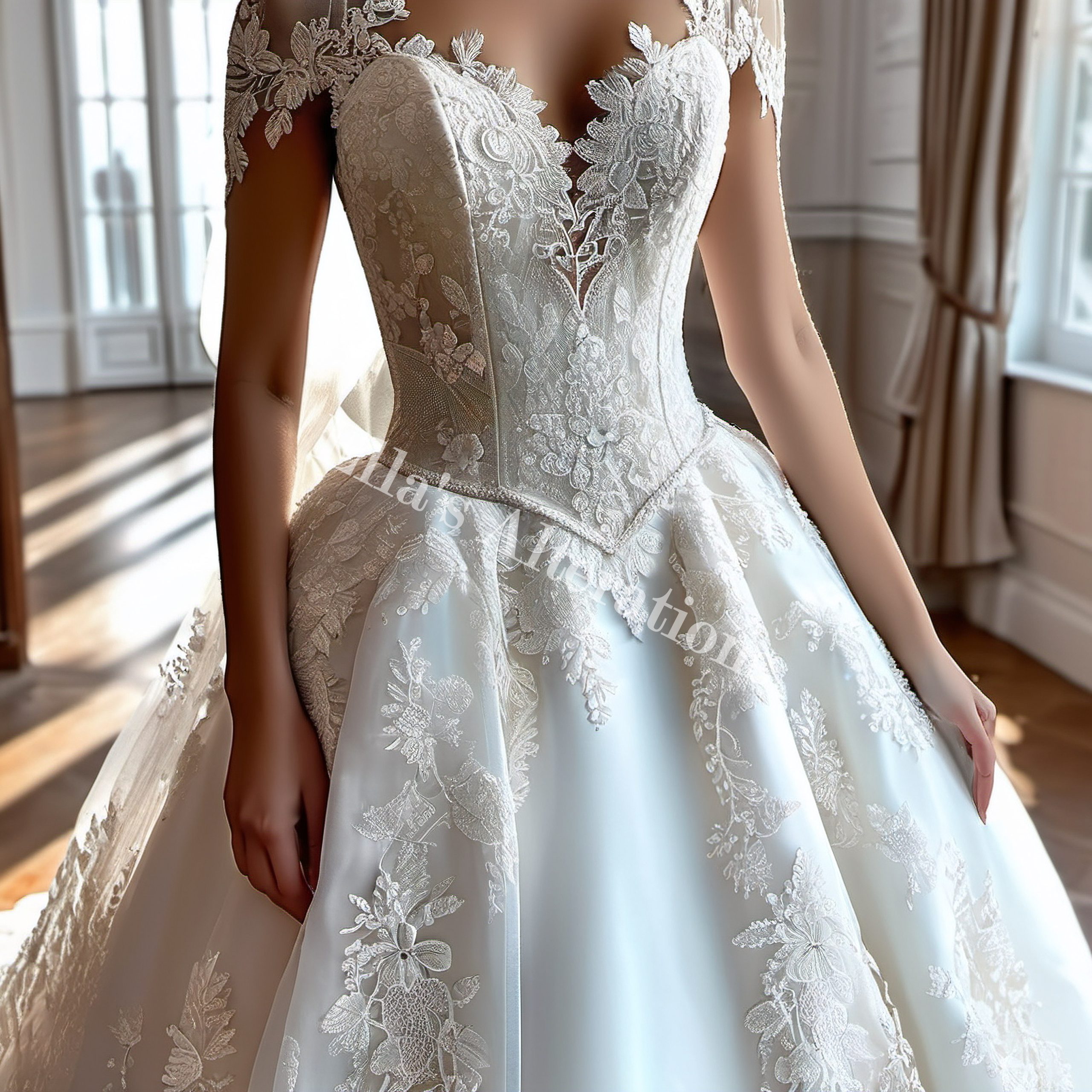
Dresses with lace overlays, hand-beaded appliqué, or delicate embroidery require extra care.
We never want bustle points to interfere with or distort the embellishment.
In these cases, we may customize a French-style bustle with strategically placed loops and ribbons inside the lining, avoiding visible anchors altogether.
Another method is to secure the bustle at seam intersections or in areas where appliqué naturally conceals stitching.
This allows us to preserve the gown’s visual design while offering complete functionality.
For gowns with illusion backs or sheer panels, transparency must also be factored in.
Placement must be hidden, and fasteners must blend with the gown’s tone and texture.
Matching the right bustle to the silhouette is a matter of precision and intuition.
As tailors, we look beyond aesthetics—we assess structure, fabric behavior, and motion.
The bustle should never compete with the silhouette.
It should serve it, shaping the dress to move as beautifully in the reception as it did down the aisle.
Best For… At-a-Glance Guide:
When it comes to matching a bustle to a bride’s gown, her silhouette is only one part of the equation.
As tailors, we consider fabric type, train length, intended movement, and even the bride’s personal style.
Every detail matters—from how she plans to dance to the weight of the gown as it shifts.
While each bustle must be customized, certain types tend to align well with specific needs.
This at-a-glance breakdown not only offers a reference—it reflects the thought process behind every professional recommendation.
American Bustle – Best For the Classic Bride with Volume
The American bustle is a favorite for a reason.
It lifts the train over the back of the gown, forming visible folds that cascade over the skirt.
Brides drawn to classic shapes like A-line and ballgown styles appreciate its symmetry and structure.
This bustle also holds up well in gowns made with sturdy materials such as satin, brocade, or taffeta.
From a tailor’s perspective, the American bustle works well when we need to create balance.
The train’s weight is supported externally, reducing strain on delicate internal seams.
It’s particularly useful for full skirts where subtle bulk from exterior folds feels natural, not distracting.
Brides who want a timeless look with crisp tailoring often gravitate toward this design.
French Bustle – Best For the Romantic Bride in a Fitted Gown
The French bustle tucks the train beneath the gown and fastens it from the inside, creating gentle draping without disrupting the exterior lines.
This design is perfect for form-fitting silhouettes like mermaid, trumpet, or fit-and-flare gowns.
It allows the gown to retain its shape while concealing the lift points from view.
As tailors, we love the French bustle for gowns with lace overlays, hand-sewn beading, or illusion panels.
It offers subtlety and grace.
The internal ribbon ties we install can be color-matched and spaced along the gown’s lining, completely out of sight.
For brides who lean into romance, vintage aesthetics, or minimalist drama, the French bustle is an ideal solution that feels intentional and understated.
Ballroom Bustle – Best For the Bride Who Wants to Dance in a Dramatic Gown
When a bride walks in with a chapel or cathedral-length train, especially one attached to a ballgown, we immediately consider the ballroom bustle.
This style lifts the entire train and tucks it under the dress to align with the front hem.
The result is a seamless floor-length skirt with no evidence of a train.
This is a tailor’s top choice for functionality.
The ballroom bustle provides total freedom of movement, especially for brides planning to dance the night away.
But it demands precision.
Multiple bustle points must be spaced evenly to avoid sagging or pulling.
Brides who want a “wow” moment at the ceremony and a full transformation for the reception will benefit most from this look.
Austrian Bustle – Best For the Fashion-Forward Bride in a Lightweight Gown
The Austrian bustle is a less conventional option, but when styled correctly, it delivers unmatched texture and originality.
This bustle uses vertical ruching to gather the train in an upward motion, creating a soft pleated look reminiscent of a drawstring.
Tailors often suggest this for gowns made of chiffon, organza, or crepe—fabrics that drape easily without becoming bulky.
This is the go-to for brides who want something striking and less traditional.
The Austrian bustle can become a design element in its own right.
It’s a balance of aesthetics and creativity, often favored by brides seeking a contemporary or couture twist.
In the end, every bustle is a collaboration between technical skill and the bride’s personal vision.
While this guide offers general recommendations, the magic happens when a tailor interprets the gown’s structure and brings a bustle to life that’s beautiful, balanced, and bridal.
Bonus Know-How: How to Add and Use Your Bustle:
Once the bustle style is chosen and matched to the gown’s silhouette, the next step is all about proper execution.
This is where the real tailoring work begins.
Adding a bustle is not a plug-and-play detail—it requires thoughtful placement, technical skill, and a keen understanding of how the gown behaves when worn.
From the first fitting to the final dance, your role as a tailor is to build a bustle that functions beautifully, remains hidden, and supports the gown without compromise.
Adding the Bustle: What to Know Before You Sew
Bustles should always be added after the hem is finalized.
The train length must be precise, and any changes to the hemline will directly affect where the bustle points should fall.
Before any bustle points are sewn in, the bride should try on the gown in the shoes she plans to wear, with the undergarments and petticoats (if any) she intends to use on the big day.
Tailors start by analyzing the train.
- Where does it naturally fold?
- How does the fabric behave when lifted?
- Does the gown have center seams, godets, lace insets, or beading that will impact where points can be anchored?
We then mark bustle placements using pins or fabric-safe chalk, always keeping an eye on balance and symmetry.
Next comes the engineering.
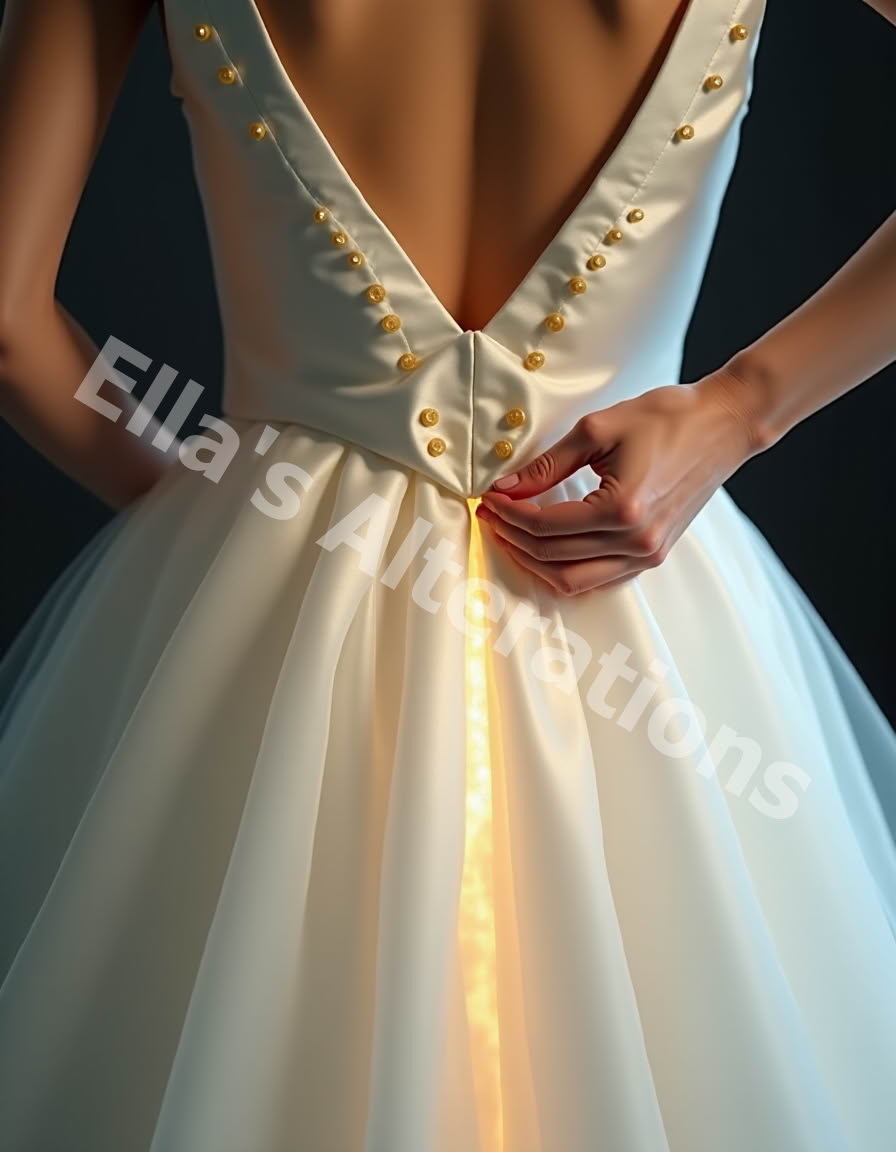
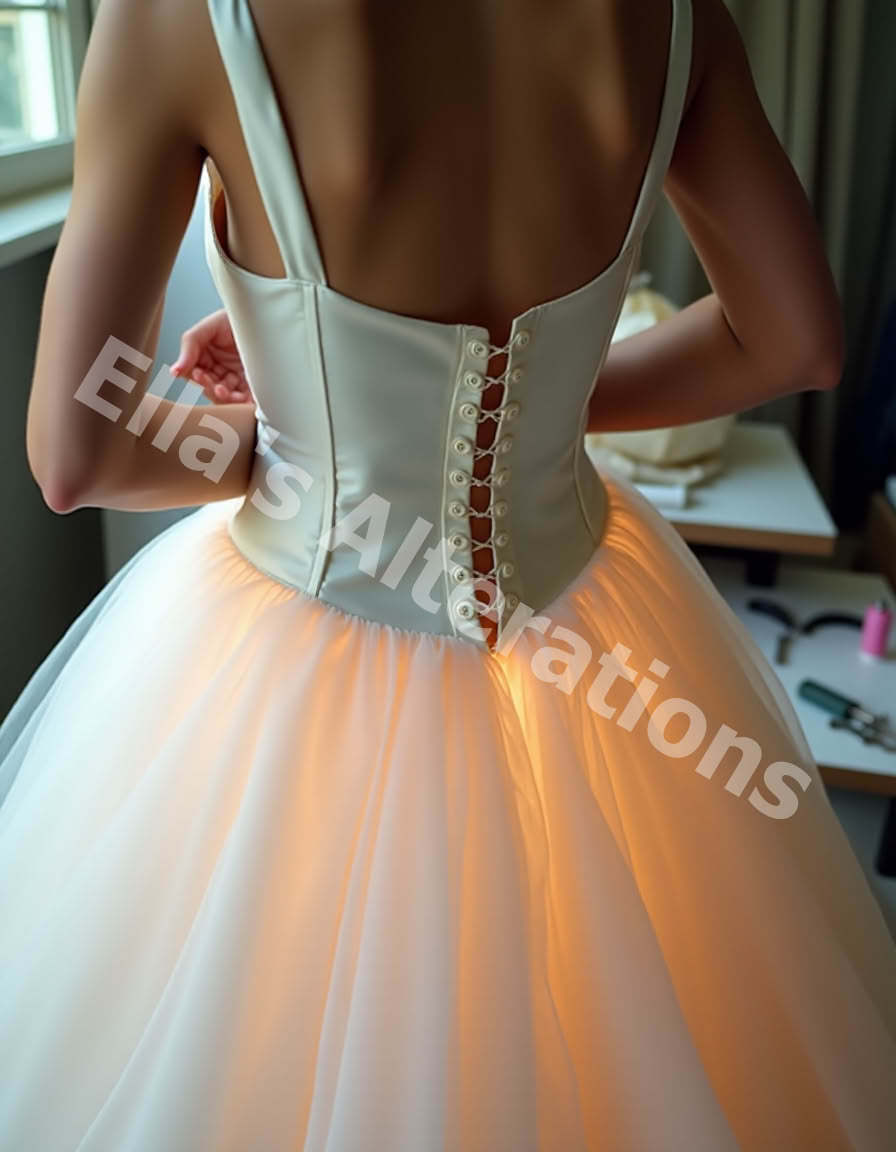
Bustle points may involve sewn loops, clear buttons, ribbon ties, or a combination of all three.
We reinforce these areas internally to bear the strain of movement and weight.
Each point must be durable yet discreet—after all, no bride wants her bustle hardware visible in photos.
How to Use the Bustle: Make It Easy, Not Stressful
A bustle is only helpful if it can be fastened quickly and correctly.
That means walking the bride—and whoever is assigned to help her on the day—through the bustle process step by step.
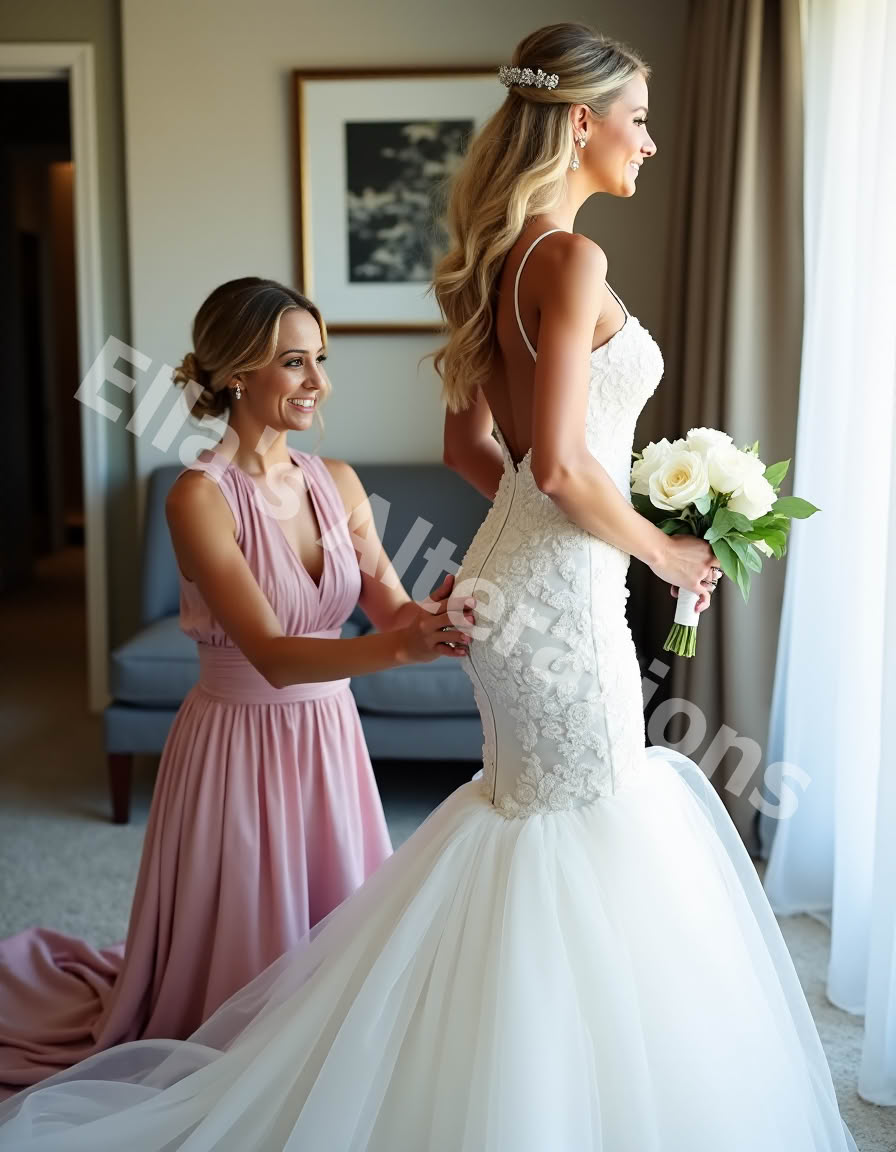
We recommend designating a specific person, usually a bridesmaid, maid of honor, or wedding planner, to learn how to lift and secure the train.
During the final fitting, we show them how to locate each bustle point, whether it’s under the lining or on the outer skirt.
We demonstrate how to fasten loops over buttons, tie ribbons through color-coded anchors, or snap hidden closures into place.
We always encourage photos or video recordings of this walkthrough—it’s easy to forget the process in the excitement of the day.
A well-installed bustle should allow the bride to walk, sit, dance, and hug without tugging, bunching, or sagging.
We often test this by asking the bride to move around the fitting room, simulating a few real-life scenarios: a slow turn, a seat at the dinner table, a hug from a family member.
This real-time motion test lets us assess and adjust tension and placement.
Timing Is Everything
So when should a bride bustle her gown?
Typically, this happens right after the ceremony or formal photos, and before the grand entrance at the reception.
Bustling too early can cause wrinkles or strain the structure during prolonged wear.
Bustling too late can be logistically tricky, especially if the train gets stepped on or dirtied during cocktail hour.
We always suggest timing the bustle during a natural pause—usually just before the reception begins.
And if the bride wants a dramatic second look moment, the bustle itself can be that reveal.
Paired with a hair change, new shoes, or a bold accessory, the transformation becomes part of the experience.
In the hands of a skilled tailor, a bustle is not just a lift—it’s an extension of the gown’s design, purpose-built for real-life wear.
When done right, it feels effortless.
The bride moves freely, the dress flows naturally, and the craftsmanship quietly supports it all.
The Professional Touch: Adding A Long Train And Bustle To Vintage Gowns.
Conclusion: A Flawless Finish for Your Big Day:
At the heart of every wedding gown is movement—walking down the aisle, stepping into the spotlight, dancing beneath the stars.
The bustle may not be the first thing a bride thinks about when choosing her dress, but it’s one of the most important elements in ensuring she feels effortless from start to finish.
For us as tailors, adding a bustle isn’t just an alteration.
It’s a transformation.
One that honors the gown’s structure, preserves the bride’s silhouette, and unlocks freedom without sacrificing style.
Throughout this guide, we’ve explored how the bustle functions as the invisible workhorse behind the dress.
We’ve talked about lifting trains, preserving hem lengths, and creating motion while maintaining beauty.
But what really makes a bustle matter is how it makes the bride feel—secure, graceful, and confident in every step.
Each bustle is tailored to fit not just the gown but the day itself.
A bride wearing a cathedral train on stone steps needs a different solution than one getting married barefoot on the beach.
That’s where the craft comes in.
Our role is to engineer a solution that supports the gown’s original design while adapting it for the rhythm of a real wedding day.
That means testing tension points, analyzing weight distribution, and making sure a simple lift doesn’t compromise the dress’s intended flow.
We don’t just sew—we sculpt.
We identify how the fabric reacts to being gathered, we plan out points that align with the gown’s seams and structure, and we place every loop and fastener with the precision of a final signature.
The goal is to make the bustle feel like it was always there.
When a bride walks into her reception and no one notices a thing?
That’s the highest compliment a tailor can receive.
It’s easy to underestimate the importance of the bustle.
- But if it’s too loose, the train drags.
- Too tight, and it distorts the silhouette.
- Misaligned, and the hemline suffers.
With tailored execution, though, the gown becomes more than just a garment—it becomes a two-in-one masterpiece, moving with grace at every phase of the celebration.
Even more important, the bustle reflects the collaboration between tailor and bride.
It’s a quiet conversation about movement, priorities, and style.
It’s a chance to adapt a runway-perfect piece into something that truly fits the moment.
When brides feel heard and understood in their fittings, the end result is a dress that not only fits perfectly but functions flawlessly.
As the day unfolds, the bustle plays its part without ever taking center stage.
The bride twirls, hugs, laughs, dances.
And through it all, her gown moves with her—never in the way, always in harmony.
That’s the power of tailored detail.
That’s the craftsmanship that elevates the ordinary into the unforgettable.
So whether it’s a single hidden loop or a full ballroom transformation, a bustle gives the gown its final touch.
It’s not just a lift.
It’s the key to finishing the dress with confidence, care, and complete intention.
And when it’s done right?
It’s the kind of tailoring that disappears into the magic of the day—exactly as it should.
FAQs:
Are bustles only for weddings?
Not at all.
While bustles are most commonly associated with wedding gowns, they’re absolutely not limited to weddings.
A bustle is a functional and stylish tailoring technique used to lift or adjust the length of a garment—so anywhere there’s a train, floor-sweeping hemline, or extra fabric that needs to be managed, a bustle can play a role.
Bustles show up in formal evening gowns, prom dresses, red carpet looks, and even stage costumes.
If a dress is designed with a dramatic train for visual impact but needs to be worn practically for movement, dancing, or travel, a bustle offers a seamless solution.
Think of it as your dress’s “convertible mode”—ceremony drama or grand entrance by day, full freedom to move by night.
Designers also use bustle-style techniques for fashion-forward silhouettes.
Couture dresses may include intentional ruching or layered gathers inspired by traditional bustles, creating dramatic volume or texture at the back of a gown.
Tailors are sometimes asked to add a bustle to vintage gowns, repurposed pieces, or cultural attire where tradition meets modern wearability.
We've even created custom bustles for maternity photo dresses, high-end floral gowns, or editorial shoots with long trains.
So no, bustles aren’t just for brides.
They’re for anyone who wants their outfit to move beautifully, stay functional, and look incredible from every angle.
Whether it’s your wedding, a gala, or prom night—if your dress has a train, a bustle might be your best-kept styling secret.
How much do bustle alterations typically cost?
The cost of adding a bustle to a wedding gown can vary widely, and for good reason—it’s one of the most custom and technical parts of bridal tailoring.
Unlike basic hemming or taking in a seam, a bustle requires structural strategy, careful fabric handling, and often multiple fittings to get just right.
So when brides ask, “How much will it cost to bustle my dress?” the honest answer is: it depends on your gown and how much work it takes to do it well.
On average, bustle alterations can range anywhere from $75 to $300 or more.
The final price depends on a few key factors:
Number of bustle points: A simple sheath or A-line dress may only need one or two points to lift the train, while a full ballgown with a cathedral-length train could require five to seven points or more.
Each point adds labor and reinforcement time.
Fabric type: Delicate lace, tulle, or heavily beaded gowns take more time and care than simple crepe or satin.
The more intricate the fabric, the more precise the work needs to be.
Bustle style: Certain bustle designs, like the ballroom or Austrian bustle, require more planning, testing, and stitching than a basic overbustle.
Tailor’s expertise and location: Experienced tailors who specialize in bridal will price according to their skill and local market.
Custom work deserves fair compensation.
Keep in mind, a well-executed bustle is worth the investment.
It lets the bride move freely and enjoy every moment without stepping on her train or worrying about damage.
It’s not just about cost—it’s about confidence, comfort, and craftsmanship.
Can I DIY a wedding dress bustle?
Technically, yes—you can DIY a wedding dress bustle.
But should you?
That depends on your skill level, the complexity of the gown, and your comfort with detailed sewing.
While it may seem like a simple matter of adding a few loops and buttons, a proper bustle involves more than just attaching pieces.
It’s a structural tailoring technique that affects the fit, flow, and movement of the entire gown.
If you’re a confident sewer with experience working on formalwear or bridal fabrics, creating a basic bustle for a lightweight gown might be within reach.
Simple A-line dresses with minimal trains can sometimes be managed with a one-point overbustle.
In that case, you could test different placements using safety pins, then sew in a button and loop after confirming the drape.
However, most wedding gowns feature heavier fabrics, delicate lace, beadwork, or layered tulle—and that’s where things get tricky.
The wrong placement can cause pulling, awkward bunching, or imbalance in the silhouette.
There’s also the challenge of making the fastenings discreet, secure, and easy for someone else to fasten on the big day.
Tailors approach bustling with precision, planning how each point will hold weight and move with the bride.
It’s more art than shortcut.
If cost is the reason you’re considering DIY, talk with your tailor first.
You may be able to find a simple, low-point solution that keeps your gown looking gorgeous and keeps stress off your plate.
After all, on your wedding day, the last thing you want to worry about is whether your bustle will hold through your first dance.
What should I tell my tailor about my bustle?
When it comes to bustling your wedding gown, clear communication with your tailor is everything.
While it may seem like a small part of your alterations, the bustle is actually one of the most customized and functional details in the entire dress.
And as tailors, we depend on you to share the right info so we can design a bustle that blends seamlessly with your gown, your wedding, and your movement.
Start by describing your wedding day plans.
Will your ceremony be outdoors, on grass or sand? Are you planning a grand entrance, a first dance, or a dress change mid-evening? The more we know about your environment and activities, the better we can choose a bustle that supports your comfort and freedom.
Next, talk to us about your dress silhouette and any fabric concerns.
Is the train lace or tulle? Does the dress have beading, embroidery, or a layered skirt? These elements influence where bustle points can be anchored without disrupting the gown’s design.
Let us know how you want the dress to look after the train is lifted.
Are you going for something traditional and voluminous, sleek and minimal, or soft and romantic?
Also, tell us who will be bustling the gown on your wedding day.
Whether it’s a maid of honor or planner, we’ll walk them through it during your final fitting.
And finally, don’t hesitate to ask questions.
Bustles aren’t one-size-fits-all, and your tailor is here to make it work beautifully for you.
The more we understand your vision and needs, the better we can turn your gown into a two-look masterpiece—functional, flattering, and flawlessly tailored.
Are bustles only for weddings?
Not at all.
While bustles are most commonly associated with wedding gowns, they’re absolutely not limited to weddings.
A bustle is a functional and stylish tailoring technique used to lift or adjust the length of a garment—so anywhere there’s a train, floor-sweeping hemline, or extra fabric that needs to be managed, a bustle can play a role.
Bustles show up in formal evening gowns, prom dresses, red carpet looks, and even stage costumes.
If a dress is designed with a dramatic train for visual impact but needs to be worn practically for movement, dancing, or travel, a bustle offers a seamless solution.
Think of it as your dress’s “convertible mode”—ceremony drama or grand entrance by day, full freedom to move by night.
Designers also use bustle-style techniques for fashion-forward silhouettes.
Couture dresses may include intentional ruching or layered gathers inspired by traditional bustles, creating dramatic volume or texture at the back of a gown.
Tailors are sometimes asked to add a bustle to vintage gowns, repurposed pieces, or cultural attire where tradition meets modern wearability.
We've even created custom bustles for maternity photo dresses, high-end floral gowns, or editorial shoots with long trains.
So no, bustles aren’t just for brides.
They’re for anyone who wants their outfit to move beautifully, stay functional, and look incredible from every angle.
Whether it’s your wedding, a gala, or prom night—if your dress has a train, a bustle might be your best-kept styling secret.
Formal Wear Dresses Wedding Prom Pageant Mother Of Bride, Bridesmaid Mother of Groom Alterations.

About Us
#EllasAlterationsLLC #WeddingDress #WeddingDressBustle #WeddingGown #BridalAlterations #WeddingTailor #Bustle #BridalStyle #WeddingTips #DressAlterations #BrideToBe #WeddingPlanning #BridalFashion #BustleTypes #WeddingHack #WeddingDayReady #DIYBustle #AmericanBustle #FrenchBustle #BallroomBustle #WeddingSeamstress #WeddingDetails #GownLove #SayYesToTheDress #WeddingDressTrain #CustomWeddingDress #BridalInspo #MermaidGown #Ballgown #WeddingParty #BustleIt
Brought to you by Ella’s Alterations
Ella’s Alterations
is trusted by brides, professionals, and families across Central Florida for one reason.
The work is done right.
Proudly serving Zephyrhills, Pasco County, Tampa, Wesley Chapel, Lakeland,
and surrounding Central Florida communities.
Clients travel from across the region for expert alterations that local shops
simply cannot match.
With over 30 years of hands on tailoring experience, Ella works at a master level.
This is not basic hemming or quick fixes. This is true garment engineering.
Wedding gowns with structure, suits that need balance, formalwear that must move
and photograph perfectly. Every adjustment is intentional and precise.
Every fitting is handled with respect, privacy, and patience.
Measurements are double checked. Details are explained.
Nothing is rushed. Nothing is guessed.
Clients return because they feel heard, supported, and confident.
Dresses are protected. Fabrics are handled correctly.
Fit decisions are made with experience, not shortcuts.
This is why generations of clients trust Ella with their most important garments.
When it has to fit perfectly, they choose experience.
Ella’s Style Confidence
If something feels off when you put it on, that does not mean it is wrong for you.
It means it has not been tailored for you yet. Clothes are made for averages.
You are not average.
The smallest adjustments change everything. A lifted waist, a shaped bust,
a clean hem. These details quietly do the heavy lifting so you can walk in
like you own the room.
If you are pulling, tugging, or holding your breath, the garment is failing you.
Real tailoring lets you move, sit, dance, and live without thinking about your clothes.
Styles come and go fast. A perfect fit never goes out of style.
When something fits you correctly, it always looks intentional and expensive.
Hidden structure matters. Boning, cups, straps, and shaping should work with your body,
not against it. When support is done right, no one sees it but everyone notices the result.
Whether it is a wedding dress, a suit, or everyday wear, your clothes should show up for you.
Sharp, polished, and reliable.
The best dressed people are not uncomfortable or flashy.
They look effortless because their clothes fit correctly and feel natural.
Fixing what you already own often gives you more confidence than buying something new.
A tailored piece feels personal. Like it was made just for you.
Posture changes. Shoulders relax. You stop adjusting and start owning your space.
That shift is what people actually notice.
Not just okay. Not just good enough. Amazing.
That is the standard.
Local Credibility
Awards & Recognition
Service Area
Depth of Craft
Proof of Trust & Fitting Care

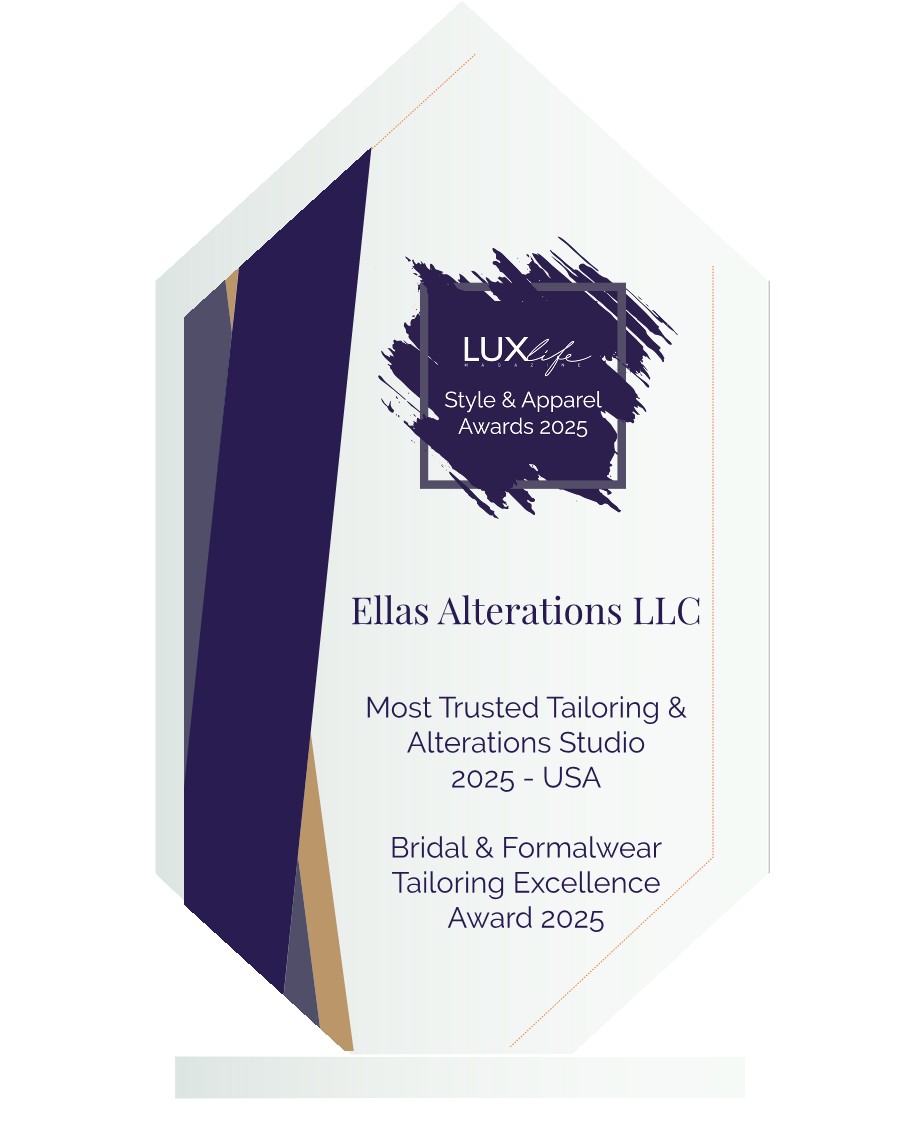
Bridal & Formalwear Tailoring Excellence Award 2025 – USA
Award Winning Bridal & Formalwear Tailoring
Ella’s Alterations is proudly recognized as one of Zephyrhills’ most trusted tailoring studios, specializing in wedding dress and formalwear alterations.

NextDoor Neighborhood Favorite 2023, 2024, 2025

Best Wedding Dress & Formalwear Tailoring Zephyrhills 2026
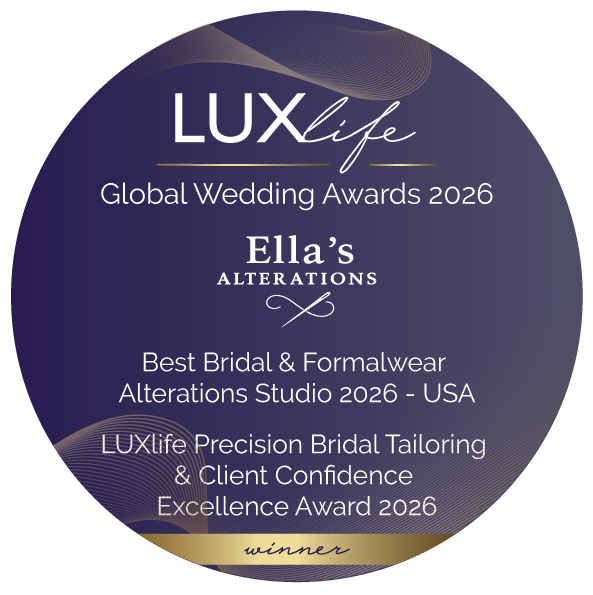
Proud winner: Best Bridal & Formalwear Alterations Studio 2026 - USA
Proud winner: Best Wedding Dress and Formalwear Tailoring, Zephyrhills 2026
Why Clients Trust Ella’s Alterations
- 30 plus Years of Expertise: Master tailoring and formal wear alterations trusted across Florida.
- Award Winning Service: Best of Florida Tailor and Best of Zephyrhills.
- Private Bridal Fittings: Discreet, elegant, and tailored to you.
- Proven Local Reputation: Five star customer reviews and repeat clients from Tampa to Orlando.
- Transparent and Personal: Clear pricing, expert guidance, and no rushed fittings.
- Recognized nationally by LUXlife Magazine for craftsmanship and client trust
- Chosen year after year for precision bridal and formal tailoring
- Best Wedding Dress & Formalwear Tailoring Zephyrhills 2026
- NextDoor Neighborhood Favorite 2023 2024 2025
Address: 6986 Fort King Road, Zephyrhills FL 33541
Phone: +1 813-445-8894 or +1 813-680-5821
Email: admin@ellasalterations.com
Hours:
Get Directions | Book Your Fitting